
Understanding the Brazilian Butt Lift: Origins, Anatomy, and Technique
The term “Brazilian butt lift” is actually a double misnomer: it is not exclusively Brazilian, and surgically speaking, it is not a lift. Traditional body-lifting procedures involve excising redundant skin and tightening underlying tissues. In contrast, gluteal fat grafting is an autologous volume-enhancement and reshaping surgery. The procedure pairs liposuction harvesting with meticulous micro-grafting to build projection, smooth out hip dips, and refine the transition between the lower back, waist, and buttocks.
Understanding anatomical tissue planes is fundamental to grasping how this procedure works. The buttock region consists of three primary layers: the cutaneous skin layer, the subcutaneous fat compartment, and the deeper gluteal musculature (the gluteus maximus, medius, and minimus). Current safety guidance limits fat injection to the subcutaneous space above the muscle fascia; careful technique and real-time ultrasound guidance are important safeguards, but they do not eliminate risk.
When patients evaluate various body sculpting options, they often discover that autologous fat transfer offers a distinct dual benefit. By sculpting donor regions like the waist and flanks, a surgeon accentuates the natural curvature of the gluteal area before any fat is even injected. For a broader understanding of how this procedure fits into the history of aesthetic surgery, the Brazilian butt lift entry provides useful context.
How a Brazilian Butt Lift Creates Natural-Looking Buttock Augmentation
Unlike synthetic gluteal implants, autologous fat grafting uses a patient’s own adipose tissue. When transferred fat survives and integrates, it may feel and move similarly to surrounding tissue. The final feel, contour, and degree of volume retention vary with the patient’s anatomy, surgical technique, healing, and later weight changes.
Furthermore, dynamic contouring allows for customized shape creation. Rather than placing a uniform silicone block, the surgeon strategically places micro-droplets of fat to fill lateral hollows, enhance superior pole fullness, or balance asymmetrical contours based on individual anatomy.
The Step-by-Step Surgical Process
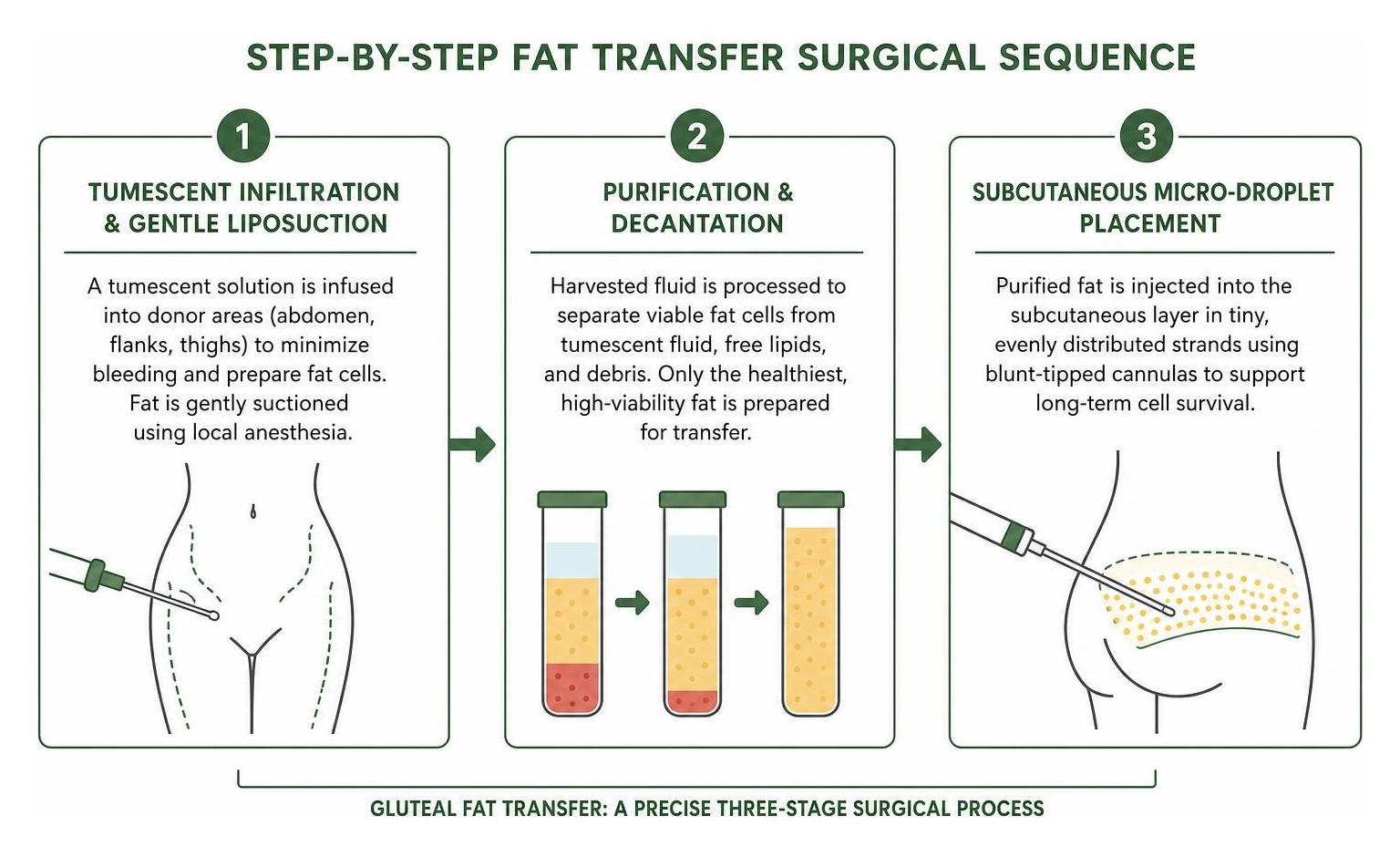
Gluteal fat transfer relies on a precise, three-stage surgical progression:
- Tumescent Infiltration & Gentle Liposuction: A specialized solution containing saline, local anesthetic, and epinephrine is infused into target donor sites such as the abdomen, flanks, or thighs. This helps limit bleeding and prepares fat cells for extraction. For selected patients, NovoSculpt may perform fat-transfer procedures awake under local anesthesia, potentially avoiding general anesthesia. The appropriate anesthetic plan depends on an individualized medical assessment and does not remove the procedure’s surgical risks.
- Purification and Decantation: The harvested fluid undergoes sterile processing, decantation, or gentle centrifugation to separate potentially viable adipose cells from tumescent fluid, free lipids, and cellular debris. The surgeon then prepares the graft for transfer.
- Subcutaneous Micro-Droplet Placement: Using specialized blunt-tipped cannulas, the surgeon places purified fat in the subcutaneous tissue plane in small, distributed passes. Current safety guidance emphasizes keeping the cannula above the muscle fascia and using real-time ultrasound to confirm its position during injection.
The Evolution of Patient Safety and Mortality Risk
In the early years of widespread gluteal fat grafting, safety data raised serious concerns. A 2017 multi-society task-force report estimated that the mortality risk could be substantially higher than for many other aesthetic procedures, with pulmonary fat embolism identified as the most serious mechanism of death. Pulmonary fat embolism can occur when fat enters large veins after deep injection and travels to the heart and lungs. It is potentially fatal.
In response, plastic surgery organizations and safety task forces issued guidance intended to reduce preventable risk. These recommendations have evolved as evidence and practice standards have developed, but no protocol eliminates every complication.
- Subcutaneous-Only Injection: Fat should be placed only in the subcutaneous layer above the deep muscle fascia, not in or below the gluteal muscle.
- Real-Time Ultrasound Guidance: Current multi-society safety guidance recommends real-time ultrasound during gluteal fat injection so the surgical team can confirm and document that the cannula remains in the subcutaneous plane. This is an important safeguard against inadvertent deep placement.
- Cannula Control and Surgical Planning: Surgeons use technique, cannula selection, patient positioning, and individualized planning to reduce risk. These measures support safer practice but cannot guarantee a complication-free outcome.
Modern safety guidance has focused on reducing the risk of fatal pulmonary fat embolism through subcutaneous-only injection and real-time ultrasound guidance. However, a single contemporary mortality estimate should not be presented as a settled guarantee of safety, and gluteal fat grafting still carries serious risks. Potential complications include pulmonary fat embolism, infection, bleeding, fat necrosis, asymmetry, contour irregularities, fluid collections, and blood clots. Patients should discuss the surgeon’s training, facility protocols, anesthesia plan, and individualized risk factors before deciding whether treatment is appropriate. Knowing how to compare plastic surgeons and spot red flags early can help prospective patients prepare for that discussion.
The Recovery Roadmap: Protecting Your Grafted Fat
The early weeks after fat transfer influence how the treated areas heal, but outcomes vary. Transferred fat cells must establish a new blood supply, and some degree of volume loss can occur during healing. Fat retention is influenced by patient factors, surgical technique, postoperative healing, and later weight changes.
Published retention figures vary across studies and should not be used as a guarantee for an individual patient. Some transferred fat may be reabsorbed, while some may persist as living tissue after it establishes a blood supply. The final result can continue to evolve for months and may change with substantial weight fluctuation or natural aging.
To protect the newly transferred fat during this vulnerable window, patients must follow specific recovery protocols:
- Pressure and Positioning: Many surgeons recommend limiting direct pressure on the grafted area for a period after surgery, but instructions about sitting, sleeping positions, and recovery pillows vary by procedure and surgeon.
- Compression Garments: Compression may be recommended for donor areas to help manage swelling and support healing. The type of garment, degree of compression, and whether the grafted area should be compressed must follow the treating surgeon’s instructions.
- Walking and Activity: Light walking may be encouraged to support circulation, while exercise and strenuous activity are reintroduced on an individualized timeline. Patients should follow their treating surgeon’s postoperative instructions for sitting, sleeping, compression, bathing, medications, travel, and return to activity.
Determining Candidacy for Gluteal Fat Transfer
A successful, natural-looking result requires careful patient selection. Ideal candidates generally meet the following anatomical and lifestyle criteria:
- Adequate Donor Fat: Candidates need enough pinchable subcutaneous fat in areas such as the abdomen, flanks, back, or thighs to harvest and purify. The amount of retained volume varies and cannot be guaranteed.
- Stable Body Weight: Patients are generally advised to be near a stable body weight because substantial weight changes can alter donor and grafted areas.
- Healthy Skin Tone and Elasticity: Dermal elasticity can affect how donor regions retract after fat extraction and how recipient areas accommodate volume. Patients exploring body contouring after weight loss may need an individualized discussion of skin laxity, fat transfer, and alternatives.
- Nicotine Use and Medical History: Nicotine can impair wound healing and tissue oxygenation. Medical conditions, medications, prior surgery, and nicotine use should be reviewed during consultation.
- Realistic Aesthetic Goals: A consultation should address anatomical limits, potential risks, expected variability in fat retention, and whether fat transfer or another approach is appropriate.
Frequently Asked Questions About Gluteal Contouring
How long does a brazilian butt lift last?
Fat that survives and establishes a blood supply may last for years, but the result is not guaranteed to be permanent. Like other adipose tissue, retained fat can enlarge or shrink with weight changes, and aging, skin quality, and healing can affect the long-term contour.
When can I sit normally after surgery?
Recommendations about sitting normally differ by surgeon, technique, and the patient’s healing. Many patients are instructed to limit direct pressure on the grafted area early in recovery and may use a thigh-support pillow when sitting is necessary. The treating surgeon should provide the timeline for resuming normal sitting, sleep positions, work, exercise, and travel.
Why can some transferred fat be reabsorbed?
During grafting, fat cells are temporarily separated from their original blood supply. As the body develops new blood vessels, some transferred cells may not receive enough oxygen and nutrients to survive. The amount of reabsorption varies and is influenced by factors including graft handling, injection technique, recipient-site conditions, healing, nicotine exposure, and later weight changes.
Conclusion
Autologous gluteal fat transfer is a body-contouring procedure that uses a patient’s own harvested fat to change the shape and volume of the buttocks. A thoughtful treatment plan requires meticulous technique, adherence to current safety guidance, and individualized postoperative care. Results and recovery vary, and the procedure carries risks that should be discussed in consultation.
NovoSculpt is a physician-led practice in Cos Cob, Greenwich, Connecticut. Selected fat-transfer procedures may be performed awake under local anesthesia when appropriate after individualized medical assessment, which may allow some patients to avoid general anesthesia. Local anesthesia does not eliminate surgical risk or guarantee a shorter recovery. Patients from Greenwich, Fairfield County, Connecticut, and nearby Westchester County, New York can visit the Cos Cob location for an individualized evaluation.
NovoBum is NovoSculpt’s physician-led, minimally invasive approach to fat transfer using a patient’s own harvested fat. It is distinct from conventional BBL approaches in how treatment is planned and delivered, but candidacy, expected volume change, retention, and risk must be assessed individually. To learn whether this approach or another body-contouring option may be appropriate, explore the NovoBum Brazilian butt lift alternative and schedule a personalized consultation with the NovoSculpt team.
References
- Mofid MM, Teitelbaum S, Suissa D, et al. Report on Mortality from Gluteal Fat Grafting: Recommendations from the ASERF Task Force. Aesthetic Surgery Journal. 2017.
- American Society of Plastic Surgeons and partner societies. Gluteal Fat Grafting Safety Advisory. Updated 2022.
Del Vecchio DA, Kenkel JM. Practice Advisory on Gluteal Fat Grafting. Aesthetic Surgery Journal. 2022.
Mowlavi A, Sin Z, Sahami C, Mantecon G, Mirzania H. Optimizing Brazilian Buttock Lift Results Using the BBL Assessment Tool. Aesthetic Plastic Surgery. 2023. PMID 36214875.
