
Is Liposuction Right for You?
Written by Roberto Magana, BSc, MBA
CEO, NovoSculpt
Last Updated: September 25, 2026
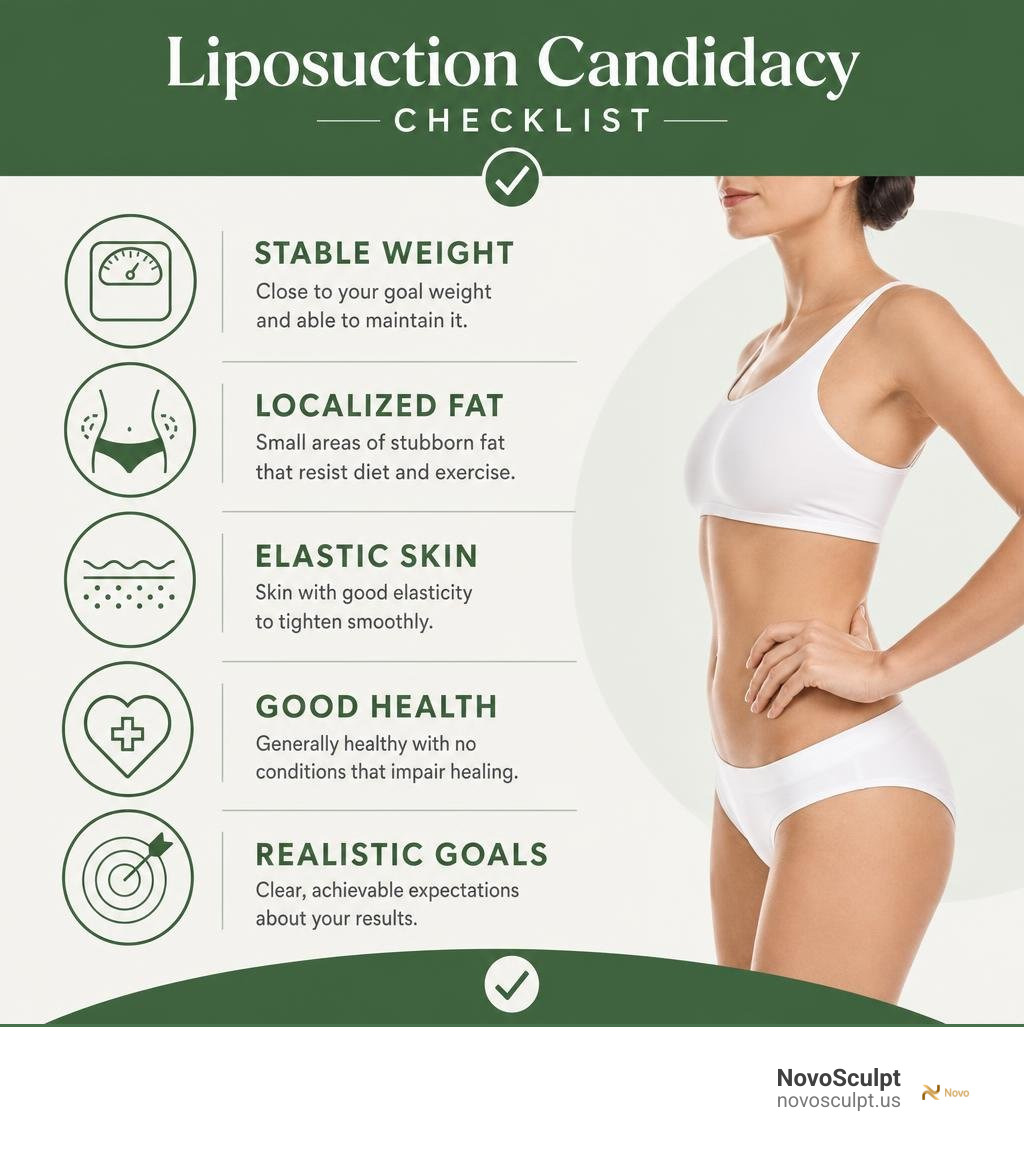
Who is a good candidate for liposuction? A typical candidate is an adult in reasonably good health who is at or near a stable weight, has localized subcutaneous fat that has not responded as desired to diet and exercise, does not use nicotine or can follow perioperative nicotine restrictions, has adequate skin quality, and has realistic expectations. Candidacy is determined individually during a clinical evaluation.
Liposuction is a surgical body-contouring procedure, not a treatment for obesity or a substitute for substantial weight loss. A consultation also considers your medical history, fat distribution, skin quality, treatment goals, and the extent of the procedure being considered.
Key Takeaways
- Liposuction is intended for body contouring, not substantial weight loss.
- Good candidates typically have localized subcutaneous fat, relatively stable weight, reasonable skin elasticity, and realistic expectations.
- Health history, medications, nicotine use, skin quality, and the extent of the planned procedure can affect candidacy.
- Being a candidate for liposuction does not automatically mean someone is a candidate for awake liposuction.
- An individualized clinical evaluation determines whether fat removal alone or another approach is appropriate.
Core Physical Criteria: Who Is a Good Candidate for Liposuction?

Liposuction is designed to remove excess fat from specific areas beneath the skin to improve body contours; it is not intended for broad weight reduction (Bartow et al., 2025). The American Society of Plastic Surgeons describes liposuction as a highly individualized procedure and emphasizes healthy nonsmokers, localized fat deposits, realistic goals, and appropriate skin and muscle tone.
As a general benchmark, the American Society of Plastic Surgeons describes ideal liposuction candidates as adults within approximately 30% of their ideal weight who have firm, elastic skin and good muscle tone. This is a general guideline rather than a guarantee of candidacy or results. Individual assessment should also consider fat distribution, skin quality, medical history, treatment goals, and the extent of the proposed procedure.
| Criteria | Often Favorable for Liposuction | May Need Further Evaluation or Another Approach |
|---|---|---|
| Weight pattern | Weight is relatively stable; goals are contour-focused | Major weight fluctuation or a primary goal of substantial weight loss |
| Fat distribution | Localized, subcutaneous fat pockets | Predominantly visceral abdominal fat or generalized obesity |
| Skin quality | Skin with reasonable elasticity for the planned area | Significant laxity, heavy folds, or substantial skin excess |
| General health | Medical conditions are stable and risks are acceptable | Uncontrolled conditions, active disease, or risks requiring optimization |
| Expectations | Understands the limits of contouring surgery | Expects major weight loss or a guaranteed aesthetic result |
Skin Quality and Age: Evaluating Candidacy for Liposuction
Skin quality is generally more relevant than chronological age. After fat is removed, the skin must adapt to the new contour, but the degree of retraction varies. Elasticity, thickness, stretch marks, prior pregnancy, prior major weight loss, and the amount and distribution of fat can all affect how the skin conforms.
Age alone does not determine candidacy. Some older adults have favorable skin quality and health profiles, while some younger adults have laxity or tissue characteristics that make fat removal alone less suitable. Significant laxity, thin or stretched skin, or substantial skin excess may make a skin-tightening or skin-excision procedure more appropriate, either instead of or in combination with fat removal. Because the degree of skin retraction after liposuction varies, significant skin excess may require a different or additional treatment approach.
Weight Stability and Target Areas
Liposuction is commonly considered for localized, diet-resistant subcutaneous fat in people whose weight has been relatively stable. Significant future weight change can alter both treated and untreated areas, so a sustainable weight-management plan remains important.
Common areas treated with liposuction include:
- The upper and lower abdomen
- Flanks and waistline (“love handles”)
- Outer and inner thighs
- Upper arms
- Submental region (under the chin)
- Back and bra-line fat deposits
For readers comparing their choices, this overview of body contouring versus weight loss explains why procedure selection should begin with the clinical goal rather than a promise of a particular result.
Medical and Health Factors That Impact Candidacy

Because liposuction is a surgical procedure, safety and recovery planning are central to candidacy. A clinician should review your health history, medications, planned treatment areas, and the expected extent of the procedure. Good overall health can support candidacy, but no single medical factor guarantees a particular recovery or outcome.
Key considerations include:
- Nicotine use: Smoking, vaping, and other nicotine products can affect blood flow and wound healing. Patients may need to stop nicotine products for a clinician-specified period before and after surgery.
- Cardiovascular and pulmonary health: Blood pressure, circulation, heart history, lung conditions, and the need for medical clearance are evaluated individually.
- Metabolic, kidney, and immune factors: Diabetes control, kidney function when clinically relevant, immune status, and other significant conditions should be reviewed case by case. Certain uncontrolled conditions, active disease states, or immunosuppressive treatments may increase procedural risk or affect healing.
- Bleeding risk and medications: Anticoagulants, antiplatelet drugs, anti-inflammatory medicines, supplements, and other medications can affect bleeding or anesthesia planning. Never stop prescribed medication without direction from the clinician managing your care.
- Procedure scope: The number of areas, amount and distribution of fat, operative time, and whether another procedure is being considered all affect planning.
For appropriately selected procedures and patients, liposuction may be performed using tumescent local anesthesia without general anesthesia. This avoids exposure to general anesthesia and its associated effects, although procedures performed under local anesthesia have their own risks and still require appropriate patient selection, sterile technique, monitoring, and postoperative care. NovoSculpt’s guide to local anesthesia versus general anesthesia for body contouring provides additional context.
Liposuction vs. Weight Loss Surgery: Identifying the Right Procedure
It is common to confuse body contouring with bariatric surgery or other weight-management care, but they address different clinical objectives:
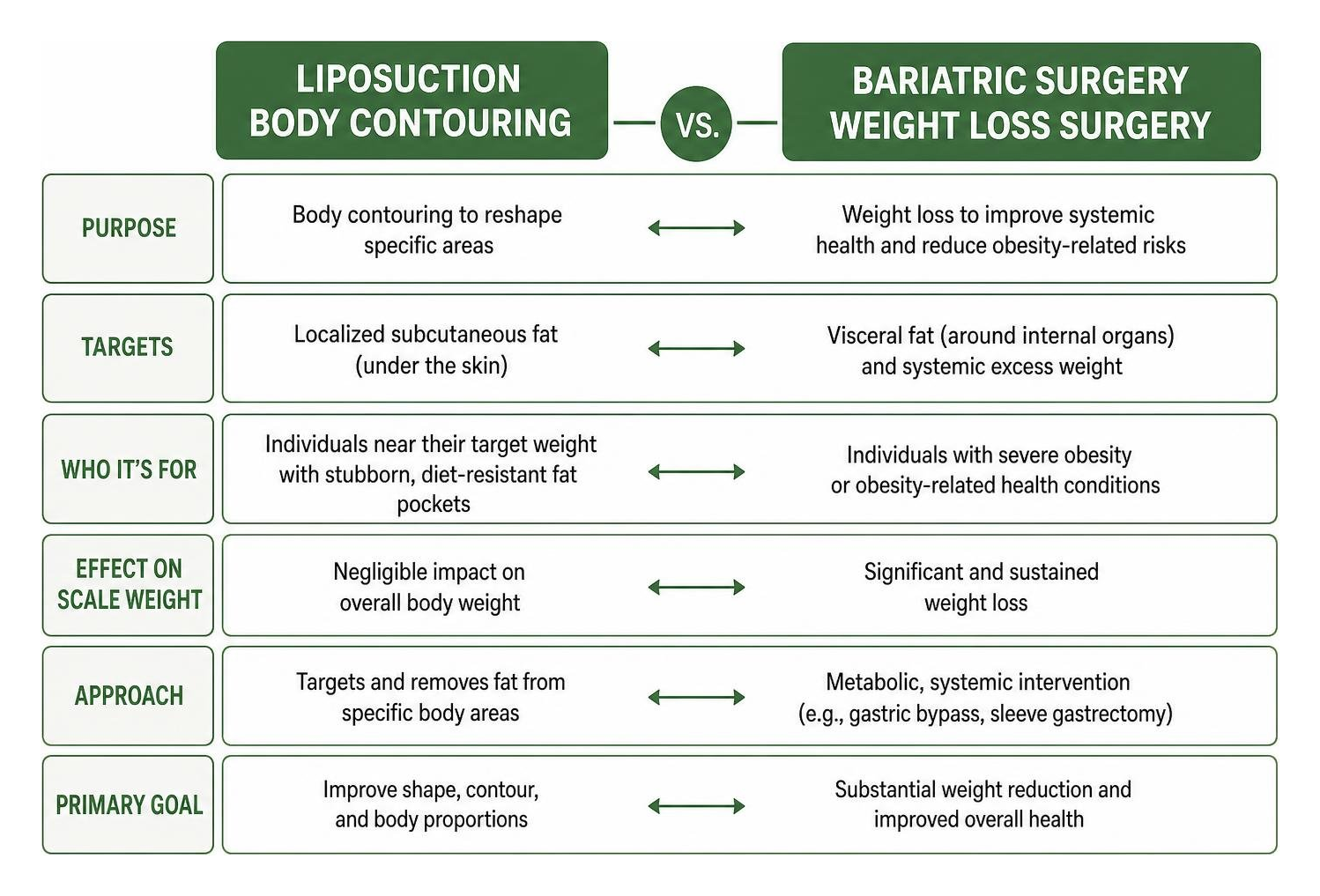
- Liposuction: Targets localized subcutaneous fat to alter body contours. The amount of fat removed varies according to anatomy, the treatment plan, procedural approach, and safety considerations. Liposuction should not be viewed as a weight-loss treatment.
- Bariatric surgery and medical weight management: Bariatric procedures, anti-obesity medical care, nutrition, physical activity, and other weight-management interventions may be used to address obesity, metabolic health, or substantial weight reduction. They are not interchangeable with liposuction.
If your primary goal is substantial weight reduction or improvement of obesity-related health concerns, discuss evidence-based weight-management options with the appropriate clinician. If you are near a stable target weight and primarily want to address localized subcutaneous fat, liposuction may be an option depending on your anatomy, skin quality, health, treatment goals, and clinical evaluation. This guide to choosing a body-sculpting procedure for your goals can help frame that conversation.
Psychological Readiness and Preparing for Your Consultation
Physical qualifications are only part of the equation; emotional readiness is just as critical. Good candidates generally have realistic expectations about what body-contouring surgery can and cannot accomplish, personally motivated goals, and an understanding of recovery and the need for long-term health habits. Liposuction can refine a contour, but it does not replace nutrition, physical activity, weight-management care, or broader health support when those are needed.
A respectful evaluation also considers whether a patient understands the limitations of surgery and is pursuing treatment for their own reasons. When significant body-image concerns or possible body dysmorphic disorder are identified, further evaluation may be appropriate before elective aesthetic surgery.
To make the most of your visit, review what to expect at a body contouring consultation. Come prepared to share:
- Your full medical history, past surgeries, current medications, and nicotine use.
- The specific areas you would like evaluated and what you hope to achieve.
- Your weight history over the last 12 to 24 months.
- Your post-procedure lifestyle plan to support your recovery and long-term results.
- Any upcoming events, travel, or commitments to help plan your recovery timeline.
Does Being a Candidate for Liposuction Mean You Are a Candidate for Awake Liposuction?
No. Being a reasonable candidate for liposuction does not automatically mean that every patient or treatment plan is appropriate for an awake, local-anesthesia approach. Suitability depends on the treatment area, amount and distribution of fat, number of areas being treated, skin quality, medical history, medications, patient comfort and tolerance, procedure duration and extent, whether additional surgery is required, and physician assessment.
For appropriately selected patients and procedures, body-contouring procedures may be performed using tumescent local anesthesia without general anesthesia. This avoids exposure to general anesthesia and its associated effects, although procedures performed under local anesthesia have their own risks and still require appropriate patient selection, sterile technique, monitoring, and postoperative care. Conventional surgical approaches or general anesthesia may be more appropriate for some patients and procedures.
NovoSculpt focuses on awake, minimally invasive body contouring under local anesthesia for appropriately selected patients. An individualized consultation determines whether localized fat removal alone is appropriate, whether additional skin tightening may be useful, whether skin excision may be more appropriate, or whether another surgical approach may better address the patient’s anatomy.
See How Awake Fat Removal Works
Want to better understand how an awake approach to fat removal differs from conventional liposuction? This NovoSculpt video explains how the procedure works, what patients can expect, and how body contouring may be performed under local anesthesia for appropriately selected patients.
Watch “The New Way to Get Liposuction Results Without Going Under” on NovoSculpt’s YouTube channel
Frequently Asked Questions About Liposuction Candidacy
Can you get liposuction if you are overweight?
Possibly, but being overweight does not by itself determine candidacy. Liposuction may be considered when the main concern is localized subcutaneous fat and the treatment plan is medically appropriate; it is not a treatment for generalized obesity or substantial weight loss. A clinician will consider weight stability, fat distribution, skin quality, overall health, and procedural scope.
What factors may make someone a poor candidate for liposuction?
Some factors may require postponement, medical optimization, further evaluation, or a different treatment rather than permanently ruling out liposuction. These can include pregnancy, active nicotine use, uncontrolled medical conditions, significant cardiovascular or pulmonary risk, bleeding disorders or medications that affect bleeding, conditions or therapies that impair healing, unrealistic expectations, or anatomy that is poorly suited to fat removal alone.
Does liposuction prevent future weight gain?
No. Liposuction removes fat cells from treated areas, but it does not prevent remaining fat cells from enlarging with future weight gain. Maintaining a stable weight through sustainable habits can help preserve the contouring result over time.
What BMI is best for liposuction?
There is no universal BMI cutoff that determines whether someone can have liposuction. The ASPS describes a general benchmark of being within approximately 30% of ideal weight, but BMI alone does not account for fat distribution, muscle mass, skin quality, medical risk, or the planned procedure. Individual clinical assessment is more useful than a single number.
Can loose skin make someone a poor candidate for liposuction?
Yes, significant loose skin can make liposuction alone less suitable because fat removal does not reliably tighten excess skin. Depending on the area and degree of laxity, a patient may benefit from a skin-tightening strategy, skin excision, or another procedure instead of—or in addition to—fat removal.
Can older adults be candidates for liposuction?
Yes. Age alone does not determine liposuction candidacy. Overall health, skin quality, medications, healing considerations, treatment goals, and the planned procedure matter more than a person’s age by itself.
Who is a good candidate for awake liposuction?
A good candidate for awake liposuction is someone whose planned treatment can be performed appropriately under tumescent local anesthesia after individualized assessment. Not every candidate for liposuction is a candidate for an awake approach; procedure extent, anatomy, medical history, medications, comfort, and whether additional surgery is needed all matter.
Conclusion
Liposuction candidacy depends on more than weight alone. Localized fat distribution, weight stability, skin quality, general health, medical risk, expectations, treatment goals, and the extent and type of procedure all matter.
An individualized consultation can help determine whether fat removal, an awake/local-anesthesia approach, skin tightening, skin excision, or another option is most appropriate. NovoSculpt provides physician-led, minimally invasive body contouring under local anesthesia for appropriately selected patients at its Cos Cob/Greenwich, Connecticut location, serving patients from Greenwich, Fairfield County, and nearby Westchester County, New York. To discuss your options, schedule a NovoSculpt consultation or review the NovoSculpt FAQs.
References
- American Society of Plastic Surgeons. Liposuction Candidates.
- Bartow MJ, Szymanski KD, Raggio BS. Liposuction. StatPearls Publishing; updated 2025.
- Thomson DR, Thomson NE, Southwick G. Screening for Body Dysmorphic Disorder in Plastic Surgery Patients. Aesthetic Plastic Surgery. 2024;48(14):2738-2743.
