
Understanding Liposuction and Subcutaneous Fat Anatomy
Written by Roberto Magana, BSc, MBA — CEO, NovoSculpt
Liposuction is a surgical body-contouring procedure that uses a cannula and suction to physically remove selected subcutaneous fat—the layer of fat beneath the skin. It is designed for localized contour concerns rather than overall weight reduction. As the Mayo Clinic explains, liposuction can be used on areas such as the abdomen, flanks, thighs, arms, back, or chin when an individualized surgical evaluation supports treatment.
What Are the Main Types of Liposuction?
The main types of liposuction are Suction-Assisted Liposuction (SAL), which uses a cannula and suction; Power-Assisted Liposuction (PAL), which uses a reciprocating cannula to help with cannula movement; Ultrasound-Assisted Liposuction (UAL), including VASER, which uses ultrasound energy before aspiration; and Laser-Assisted Liposuction (LAL), which uses laser energy to assist fat disruption and create thermal tissue effects. Awake liposuction describes the anesthesia and treatment setting—selected procedures performed under local tumescent anesthesia—not a separate fat-removal mechanism. The appropriate approach depends on anatomy, treatment area, goals, planned anesthesia, and surgeon assessment.
Distinguishing Fat Removal From Weight Loss Procedures
Liposuction is not a substitute for weight-loss treatment, bariatric care, nutrition counseling, exercise, or treatment for metabolic disease. Its primary purpose is to change contour by removing selected localized deposits of subcutaneous fat.
This distinction matters: the body contains both subcutaneous fat and visceral fat, which surrounds internal organs in the abdomen. Liposuction targets subcutaneous fat; it does not remove visceral fat or treat the health risks associated with excess visceral fat. A person’s overall weight reflects many tissues and body systems, so contour changes after liposuction should not be framed as meaningful whole-body weight loss.
Superficial vs. Deep Adipose Layers and Zones of Adherence
Subcutaneous fat is not a single uniform layer. It includes deeper, looser adipose tissue closer to the muscular fascia and more superficial tissue beneath the dermis, connected by fascial structures and fibrous attachments. Understanding these planes helps a surgeon plan smooth contour transitions while respecting tissue support.
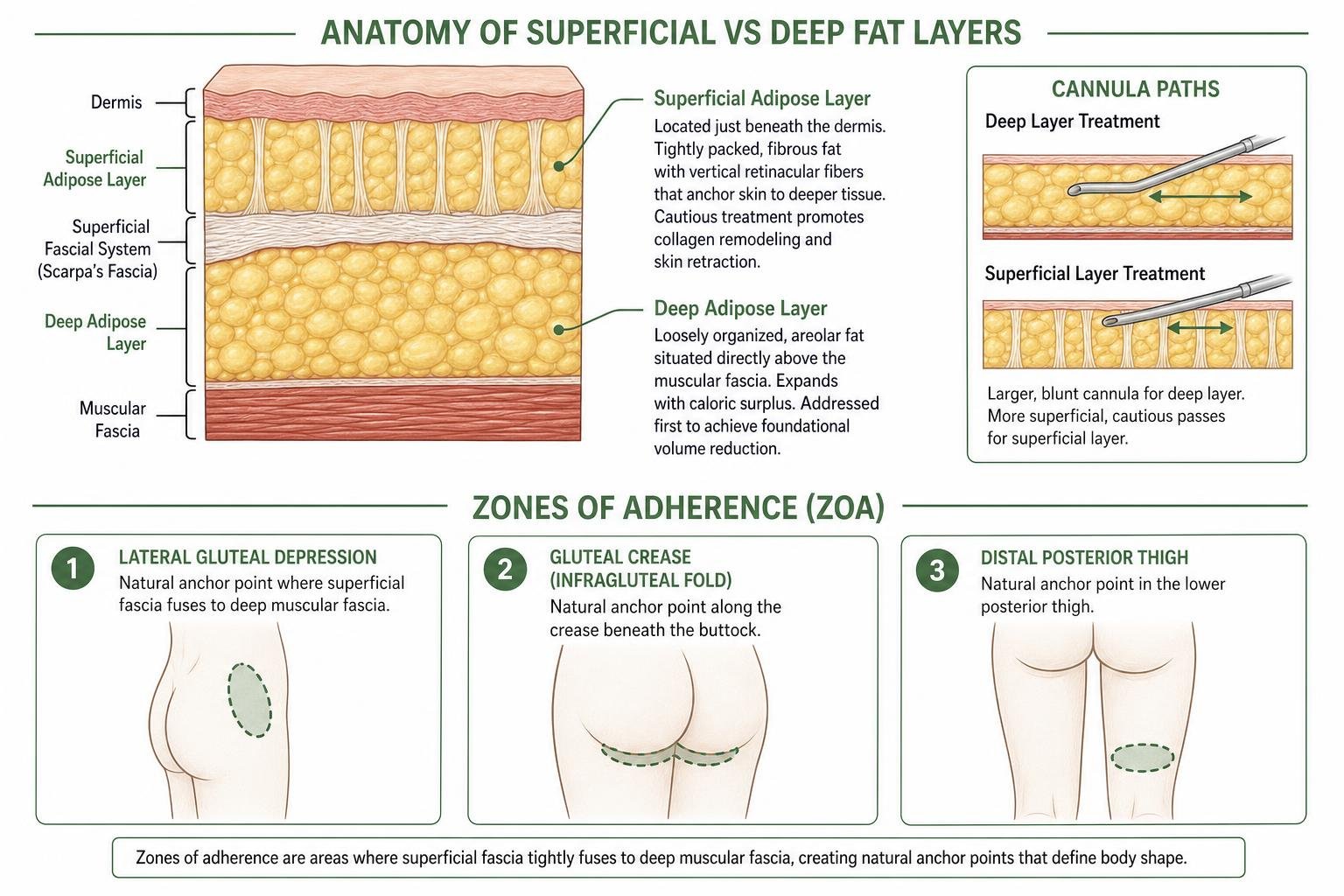
- Deeper subcutaneous fat: This is often the primary plane considered for volume reduction in areas such as the abdomen, flanks, and thighs.
- Superficial subcutaneous fat: This layer is closer to the skin and contains denser fibrous connections. Treatment requires careful judgment because overly aggressive removal can contribute to visible irregularities.
Skin redraping after fat removal varies with skin elasticity, age, anatomy, laxity, the amount and location of fat removed, technique, and healing. Energy-assisted approaches may be used with the intent of affecting tissue contraction in selected cases, but liposuction should not be presented as a predictable replacement for a skin-tightening or skin-excision procedure when substantial laxity is present.
Zones of adherence are areas where fascial attachments help define natural body contours. Important examples include the gluteal crease, lateral gluteal depression, portions of the thigh, and the iliotibial region. Overly aggressive treatment in these areas can contribute to depressions, asymmetry, or other undesirable contour changes, which is why contour planning focuses on proportion and smooth transitions rather than simply removing the greatest possible amount of fat.
Comparing Surgical Body Contouring Modalities and Cannula Technologies
Modern liposuction techniques use the same core concept—cannula-based removal of selected subcutaneous fat—but may differ in how the tissue is prepared or how the cannula is moved. The NCBI StatPearls overview of liposuction describes the evolution of suction, power-assisted, ultrasound-assisted, and laser-assisted approaches. No technology is universally superior: outcomes and recovery depend on treatment extent, anatomy, surgeon experience, anesthesia, combination procedures, and individual healing.
| Modality | Primary mechanism | Situations that may be discussed | Important considerations |
|---|---|---|---|
| Suction-Assisted Liposuction (SAL) | Cannula manipulation with vacuum suction | General localized subcutaneous fat removal | Established mechanical approach; results depend on planning and technique |
| Power-Assisted Liposuction (PAL) | Reciprocating or oscillating cannula movement | Some fibrous areas, larger treatment areas, or revision settings | Can facilitate cannula movement; it does not guarantee less bruising, pain, or recovery time |
| Ultrasound-Assisted Liposuction (UAL / VASER) | Ultrasound energy assists fat disruption before aspiration | Selected fibrous or high-definition applications | Energy-related and thermal-injury considerations apply; careful technique is essential |
| Laser-Assisted Liposuction (LAL) | Laser energy assists fat disruption and creates thermal effects | Selected small areas or thermal-assisted treatment plans | Skin response varies; thermal injury is a potential risk |
Technical Comparison of Traditional and Advanced Liposuction Methods
The most appropriate liposuction approach depends on the treatment area, tissue characteristics, treatment goals, surgeon experience, planned anesthesia, and individual anatomy.
- SAL is the established suction-assisted approach. A cannula is moved through the planned subcutaneous layer while suction removes selected fat.
- PAL uses a mechanically reciprocating cannula. In selected situations, this motion may facilitate cannula movement, particularly where tissue is denser or treatment is more extensive. It should not be interpreted as a promise of faster recovery or a better outcome.
- UAL/VASER uses ultrasound energy to assist disruption or emulsification of adipose tissue before aspiration. It may be considered in selected fibrous areas, but it also requires attention to energy-related risks, including thermal injury.
- LAL uses laser energy to assist fat disruption and create controlled thermal effects. Although thermal approaches may be associated with tissue contraction in selected applications, clinically meaningful skin tightening is not predictable for every patient.
Which Liposuction Approach May Be Considered?
| Patient / treatment consideration | Approach that may be discussed | Important limitation |
|---|---|---|
| General localized subcutaneous fat | SAL or PAL, depending on the treatment plan | Technology alone does not determine the outcome |
| Dense or fibrous tissue | PAL or selected energy-assisted approaches | Individual anatomy and surgeon experience matter |
| Selected fibrous or high-definition applications | UAL/VASER may be considered | Energy-related risks and technique-specific considerations apply |
| Small selected areas or a thermal-assisted plan | LAL may be considered | Skin response varies, and thermal injury is possible |
| Patient seeking to avoid general anesthesia | Awake/local-anesthesia liposuction may be considered when clinically appropriate | Not every patient or procedure is suitable for local anesthesia alone |
| Significant loose skin | Liposuction alone may be insufficient | Skin-tightening or excisional treatment may be more appropriate |
| Visceral abdominal fat | Liposuction is not an appropriate treatment | Liposuction treats subcutaneous, not visceral, fat |
For patients exploring circumferential contouring, NovoSculpt’s Novo360 versus traditional Lipo 360 comparison can help frame the discussion around treatment planning rather than a one-size-fits-all technology claim.
Fluid Infiltration, Tumescent Anesthesia, and Awake Liposuction
Wetting solutions are used to prepare tissue for liposuction. In tumescent techniques, a dilute local anesthetic solution is introduced into the treatment area, often with epinephrine to support vasoconstriction. These techniques have helped make selected liposuction procedures possible in an outpatient setting, including some procedures performed with the patient awake under local anesthesia.
When a procedure is performed entirely under local anesthesia, the patient avoids exposure to the risks, physiologic effects, nausea, grogginess, and recovery specifically attributable to general anesthesia itself. This does not make the procedure risk-free or mean local anesthesia is appropriate for every patient or every operation.
The exact formulation, volume, local-anesthetic exposure, monitoring plan, and anesthesia approach are individualized. For additional context, see NovoSculpt’s discussion of awake versus traditional liposuction.
Clinical Candidacy, Safety Protocols, and Complication Prevention
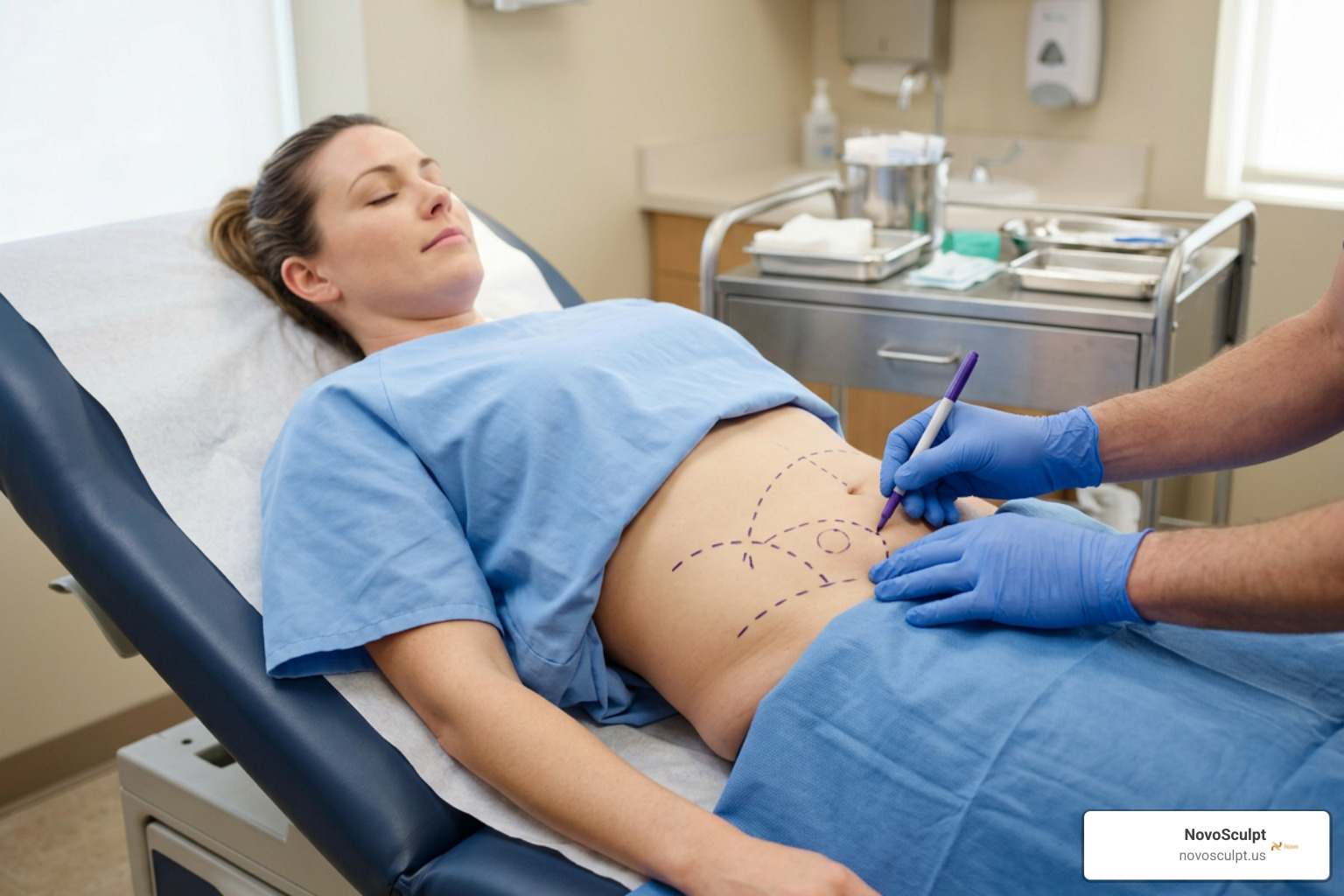
A successful liposuction plan begins with individualized candidacy assessment, realistic expectations, and appropriate surgical safeguards. Liposuction is an invasive procedure, so a consultation should evaluate both the contour concern and the factors that affect procedural suitability.
Individualized Candidacy and Treatment Planning
There is no universal BMI cutoff or fixed weight-stability interval that applies to every candidate. Relevant considerations can include overall health, medical history, body composition, fat distribution, skin quality, treatment extent, medications, nicotine exposure, thromboembolic risk, expectations, planned anesthesia, and whether another procedure is being considered at the same time.
Stable weight is generally desirable because significant future weight change can alter body contour. Skin quality also matters: when substantial laxity or redundant skin is present, fat removal alone may not address the concern, and a complementary skin-focused or excisional procedure may be more appropriate.
Nicotine exposure can impair wound healing and vascular function. Patients should disclose smoking, vaping, nicotine products, and nicotine-replacement products to their treating surgeon, who can provide individualized cessation guidance based on the planned procedure and personal risk factors. Realistic expectations and psychological readiness are also important parts of elective cosmetic-procedure assessment; a formal psychological evaluation is not inherently required for every patient.
Understanding Risks and Risk Reduction
All surgical procedures carry risks. Potential liposuction complications can include bleeding, infection, fluid-related issues, anesthesia-related complications, contour irregularities, asymmetry, skin changes, numbness, and the possibility of revision. Surgical teams assess patient-specific risks and use appropriate planning, monitoring, sterile technique, and postoperative guidance.
Local Anesthetic Systemic Toxicity (LAST)
Local anesthetic systemic toxicity is a rare but potentially serious complication of excessive systemic local-anesthetic exposure. Safe tumescent anesthesia requires individualized dose calculation, attention to total local-anesthetic exposure, appropriate monitoring, recognition of toxicity symptoms, and readiness to manage an emergency. Possible warning manifestations can include unusual numbness, metallic taste, ringing in the ears, dizziness, confusion, tremors, or more serious neurologic and cardiovascular symptoms. This article is not an emergency-treatment protocol; urgent symptoms require immediate medical attention.
Thromboembolic and Other Systemic Risks
Blood-clot risk is assessed in the context of factors such as medical history, mobility, medications, treatment extent, and planned surgery. Depending on the patient and setting, prevention strategies may include individualized perioperative planning and postoperative movement guidance. No specific NovoSculpt protocol is assumed here.
Fat Embolism and Contour Irregularities
Fat embolism syndrome is rare but serious. It should be discussed proportionately as a potential surgical complication; risk is influenced by the procedure, tissue planes, patient factors, and clinical circumstances rather than eliminated by a single fixed step.
Contour irregularities can result from uneven removal, over-resection, under-resection, fibrosis, scarring, or changes in skin quality. Management may range from observation and conservative care to scar treatment, structural fat grafting, or other revision strategies, depending on the specific problem. Patients considering revision options can review NovoSculpt’s minimally invasive liposuction overview before arranging an individualized consultation.
Healing Milestones, Compression Garments, and Long-Term Outcomes
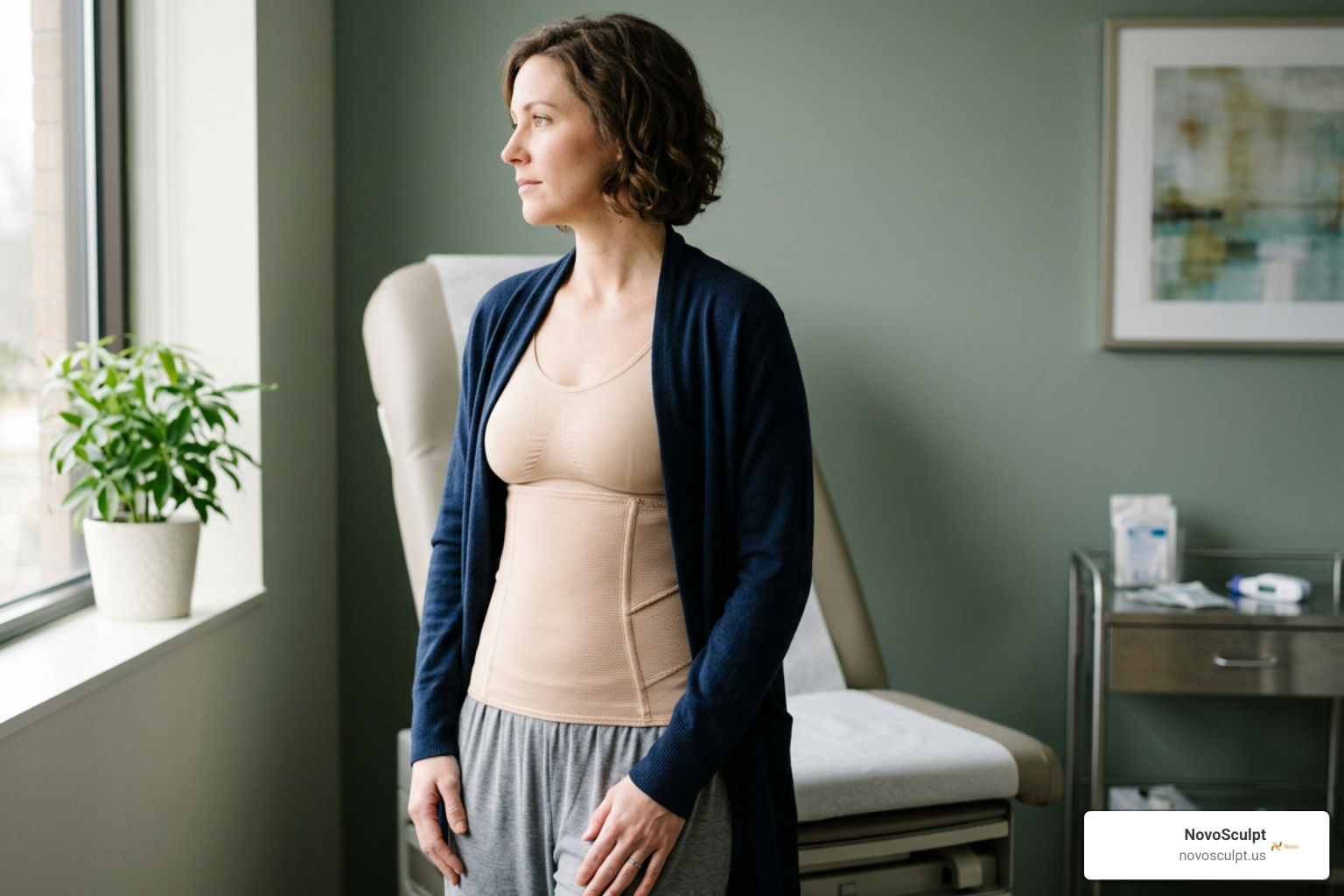
Recovery after liposuction is individual. It can vary according to the number and size of treatment areas, the amount of fat removed, technique, anesthesia, combination procedures, skin quality, swelling and bruising, personal healing, and the surgeon’s postoperative protocol.
Illustrative Liposuction Recovery Timeline
- First several days: Some patients experience drainage from small access sites, swelling, bruising, soreness, and temporary changes in sensation. Your surgeon will provide instructions about dressings, activity, and when to call the office.
- First one to two weeks: Many patients gradually return to light daily activities or desk-based work, depending on treatment extent and how they feel. Swelling and bruising may still be noticeable.
- Following weeks: Tenderness, firmness, and swelling often continue to improve. Your surgeon may guide the return to exercise and more strenuous activity based on healing and the procedure performed.
- Weeks to months: Final contour continues to evolve as swelling resolves and tissues settle. The pace differs among patients and treatment areas. For area-specific guidance, see NovoSculpt’s abdominal liposuction recovery overview.
Compression Garments and Follow-Up
Compression garments are commonly recommended after liposuction to provide support and may help manage swelling and comfort in selected patients. They do not guarantee smooth skin redraping or prevent every complication. The garment style, fit, and duration of use should follow the treating surgeon’s protocol and the details of the treatment plan.
How Long Liposuction Results Last
Fat cells physically removed from a treated area are removed. Liposuction does not remove every fat cell from that area, and remaining fat cells can enlarge with future weight gain. Body contour can also change over time because of aging, skin laxity, pregnancy, weight changes, and individual anatomy.
Maintaining a stable weight, following postoperative guidance, and supporting overall health can help preserve the proportional changes achieved with body contouring. The goal is not a promised permanent contour, but a thoughtful change in localized fat distribution that continues to be influenced by the patient’s body over time.
What Liposuction Cannot Correct
Liposuction may not be the right treatment for every concern. It does not correct:
- Visceral fat or obesity-related metabolic disease
- Significant muscle separation, such as diastasis recti
- Substantial redundant skin
- Every form of cellulite
- All pre-existing contour irregularities
- Underlying skeletal or anatomical proportions
Depending on anatomy, a patient may benefit more from weight-management care, a skin-focused treatment, an excisional procedure, muscle repair, or a combined approach.
Frequently Asked Questions About Liposuction
What are the different types of liposuction?
SAL, PAL, UAL/VASER, and LAL are commonly discussed liposuction approaches. They share the goal of removing selected subcutaneous fat but differ in how the cannula is moved or how energy may be used to assist fat disruption before aspiration.
What is the difference between SAL and PAL liposuction?
SAL uses manual cannula movement with suction. PAL uses a mechanically reciprocating cannula that may facilitate cannula movement in selected areas. Neither approach is automatically better for every patient.
What is VASER or ultrasound-assisted liposuction?
VASER is a form of ultrasound-assisted liposuction. Ultrasound energy is used to assist fat disruption before aspiration and may be considered for selected fibrous areas. It also carries technique-specific and energy-related considerations, including thermal injury risk.
What is laser-assisted liposuction?
Laser-assisted liposuction uses laser energy to assist fat disruption and produce thermal tissue effects before or during aspiration. It may be discussed for selected treatment plans, but skin response and the degree of visible tightening vary.
Can liposuction be performed while awake?
Selected procedures can be performed awake under local tumescent anesthesia when clinically appropriate. Awake liposuction describes an anesthesia and treatment-setting approach, not a separate method of removing fat. Local anesthesia is not appropriate for every patient or every operation.
Is liposuction a weight-loss procedure?
No. Liposuction is primarily a body-contouring procedure for selected localized subcutaneous fat. It does not treat obesity or replace medical weight-management care.
Does liposuction remove visceral fat?
No. Liposuction treats subcutaneous fat beneath the skin. It does not remove visceral fat surrounding internal organs.
Does liposuction tighten loose skin?
Not reliably. Skin redraping varies with elasticity, age, anatomy, laxity, treatment extent, technique, and healing. Patients with substantial loose skin may need a skin-focused or excisional treatment rather than liposuction alone.
How long does liposuction recovery take?
Recovery varies. Some patients resume light daily activities within days, while swelling, firmness, and contour refinement can continue for weeks to months. Your surgeon’s instructions should guide return to work, exercise, and other activities.
How much fat can be removed with liposuction?
There is no single appropriate amount for every patient. The amount considered appropriate depends on anatomy, overall health, treatment setting, planned areas, anesthesia, total procedure extent, surgeon assessment, and applicable facility or regulatory requirements. Aspirate volume is not the same as pure-fat weight.
Can fat return after liposuction?
Fat cells removed from the treated area are physically removed, but liposuction does not remove every fat cell. Remaining cells can enlarge with future weight gain, and body contour can change with aging, pregnancy, skin laxity, and anatomy.
How do I know which liposuction technique is appropriate for me?
A consultation should evaluate your goals, treatment area, tissue characteristics, skin quality, medical history, planned anesthesia, and whether another procedure may better address the concern. The choice should be individualized rather than based on a claim that one device is best for everyone.
Conclusion
Liposuction is a surgical option for direct physical removal of selected localized subcutaneous fat. Choosing among SAL, PAL, VASER/UAL, laser-assisted, and awake local-anesthesia approaches requires individualized planning that considers both fat distribution and skin quality, as well as the patient’s goals, health, anatomy, and recovery needs.
At NovoSculpt in Cos Cob/Greenwich, Connecticut, appropriately selected patients can undergo physician-led awake body contouring under local tumescent anesthesia. When a procedure is performed entirely under local anesthesia, it avoids exposure to the risks, physiologic effects, nausea, grogginess, and recovery specifically attributable to general anesthesia itself. This does not make the procedure risk-free or mean local anesthesia is appropriate for every patient or every operation.
NovoSculpt’s specialty-trained, fully accredited plastic surgeons who graduated from U.S. universities use individualized contour planning to evaluate localized fat and skin separately, with complementary skin-management options considered when appropriate. Patients travel to the Cos Cob/Greenwich location from Greenwich, Fairfield County, Stamford, and nearby Westchester County, New York. To discuss candidacy and recovery expectations, request a private consultation.
Scientific References
- Mayo Clinic. Liposuction: Overview, risks, and expectations.
- Bartow MJ, Szymanski KD, Raggio BS. Liposuction. StatPearls Publishing; updated 2025.
This patient-education article is not a substitute for a personal consultation, diagnosis, or individualized surgical advice.
