
Understanding Liposuction Stamford CT Options and Modern Techniques
Body contouring has advanced far beyond traditional hospital-based surgeries. When diet and exercise fail to shift stubborn subcutaneous fat deposits, modern surgical fat removal steps in to refine proportions.
At its core, surgical fat removal targets localized adipocytes (fat cells) residing between the skin and underlying muscle wall. Unlike non-invasive spa treatments that rely on external cooling or heat with variable results, minimally invasive surgery physically removes these cells.
The foundation of modern body contouring rests on tumescent fluid infiltration. This specialized solution contains sterile saline, diluted lidocaine, and epinephrine:
- Saline base: Acts as the fluid carrier and helps infiltrate the treatment area.
- Lidocaine: Provides local anesthesia that reduces sensation in the treated tissues; comfort and sensation can vary by patient and procedure.
- Epinephrine: Produces vasoconstriction, which helps reduce bleeding during the procedure.
Once adequate local anesthesia has been established, thin specialized instruments known as micro-cannulas are introduced through tiny entry points. These instruments gently loosen and aspirate localized fat deposits. To dive deeper into the mechanics, read Everything You Need To Know About Liposuction Without Being Asleep to learn how modern awake techniques use local anesthesia and direct fat removal.
Awake Liposuction Stamford CT vs Traditional General Anesthesia
Liposuction may be performed under local anesthesia, sedation, or general anesthesia, depending on the procedure and patient. General anesthesia involves exposure to general-anesthetic medications and certain associated risks, while each approach has its own surgical and anesthetic considerations.
NovoSculpt’s physician-led awake approach uses targeted tumescent local anesthesia rather than general anesthesia, so patients remain conscious and responsive during treatment. Avoiding general anesthesia does not eliminate surgical or local-anesthetic risks, and local anesthesia is not automatically the safest option for every patient.
Choosing awake fat reduction offers distinct clinical advantages:
- No General-Anesthetic Medications: For appropriately selected patients, an awake local-anesthesia approach avoids exposure to general-anesthetic medications and certain associated risks.
- Responsive Treatment Setting: Patients remain awake and can communicate with the clinical team during treatment.
- Potential Recovery Convenience: Some appropriately selected patients may return to light activity sooner, but recovery depends on treatment extent, technique, anatomy, and individual healing.
- Individualized Planning: The treating surgeon determines whether an awake approach, sedation, or general anesthesia is appropriate for the planned procedure and patient.
If you are weighing your surgical choices, exploring Why Choose Novosculpt Over Traditional Liposuction Near You highlights the core benefits of our physician-led awake technique over hospital-based surgery.
Popular Target Areas for Liposuction Stamford CT Patients
Genetics often dictate where our bodies store stubborn fat, creating localized areas that resist even the most dedicated fitness routines. Awake body contouring addresses these areas with artistic precision:
- Abdomen: Localized abdominal fat can be assessed alongside skin quality, muscle contour, and the amount of correction requested.
- Flanks: Treating the waist and flank area may help refine the transition between the torso and hips when clinically appropriate.
- Submental Area: Fat beneath the chin and jawline can be evaluated in relation to skin elasticity and overall facial anatomy.
- Inner and Outer Thighs: Thigh treatment is planned around fat distribution, skin quality, and the desired lower-body contour.
- Upper Arms: Upper-arm fullness requires an individualized assessment of fat volume and skin laxity.
- Male Chest: Pseudogynecomastia primarily involves excess fatty tissue and may respond to fat removal. True gynecomastia includes glandular breast tissue, which may require surgical excision in addition to fat removal.
For Fairfield County residents exploring customized solutions, our specialized Stamford Ct Body Sculpting approaches focus on personalized anatomic harmony. Men dealing with midsection fullness or chest accumulation can also explore Body Contouring For Men Dad Bod Stamford for targeted male aesthetic options.
Candidacy, Benefits, and Comparing Liposuction Techniques
Determining whether body contouring is appropriate involves reviewing general medical health and relevant risk factors, body mass index and anatomy, tissue characteristics, the extent of the proposed procedure, and personal aesthetic goals.
Ideal candidates share several key characteristics:
- General Health and Risk Factors: The treating plastic surgeon reviews medical history, medications, smoking status, and other relevant risks.
- Body Mass Index, Anatomy, and Weight Stability: Suitability is individualized rather than based on a single weight threshold.
- Localized, Subcutaneous Fat Deposits: The procedure targets fat beneath the skin, not visceral fat stored deep around internal organs.
- Skin Quality and Elasticity: Skin contraction varies with elasticity, age, anatomy, treatment technique, and whether an additional skin-tightening procedure is performed.
- Realistic Expectations and Procedure Scope: Body contouring reshapes selected areas; it is not a treatment for obesity or a substitute for medical weight management.
Fat cells physically removed during liposuction are not restored as the same cells. However, remaining fat cells can enlarge with weight gain, and adipose tissue can undergo longer-term biological changes. Maintaining a relatively stable weight generally helps preserve the resulting contour.
| Feature | Awake Tumescent Body Contouring | Conventional Liposuction | Non-Surgical Fat-Reduction Technologies |
|---|---|---|---|
| Anesthesia Type | Tumescent local anesthesia while the patient remains awake | Local/tumescent anesthesia, sedation, or general anesthesia depending on the procedure and patient | Usually no surgical anesthesia; technology-specific comfort measures may be used |
| Approach | Physician-led, minimally invasive direct fat removal with micro-cannulas | Surgical direct fat removal with cannulas; conventional techniques may also use tumescent fluid | Non-surgical technologies that target selected fat deposits externally |
| Treatment Planning | Based on anatomy, treatment areas, and surgeon assessment | Based on anatomy, treatment areas, and surgeon assessment | Based on applicator suitability, technology, and selected fat deposits |
| Recovery | Varies by treatment extent, technique, anatomy, and individual healing; some selected patients return to light activity relatively soon | Varies by anesthetic plan, treatment extent, technique, anatomy, and individual healing | Often involves little procedural downtime, though sessions and visible changes may develop gradually |
| Effect on Fat Deposits | Physically removes subcutaneous fat in treated areas | Physically removes subcutaneous fat in treated areas | Generally produces more gradual and limited reductions in selected fat deposits; results vary by technology |
| Skin Response | Depends on skin elasticity, age, anatomy, technique, and whether skin-tightening treatment is added | Depends on skin elasticity, age, anatomy, technique, and whether skin-tightening treatment is added | Varies by technology and individual tissue characteristics |
| Setting | Physician-led private clinical suite | Private surgical suite, ambulatory center, or hospital setting as appropriate | Clinical office or medspa setting, depending on the technology |
Recovery Process and Step-by-Step Results Timeline
Understanding the recovery journey helps you plan your schedule with confidence. NovoSculpt’s awake technique avoids general anesthesia, and some appropriately selected patients may experience a relatively convenient recovery. Downtime and healing still vary by treatment extent, technique, anatomy, and individual recovery.
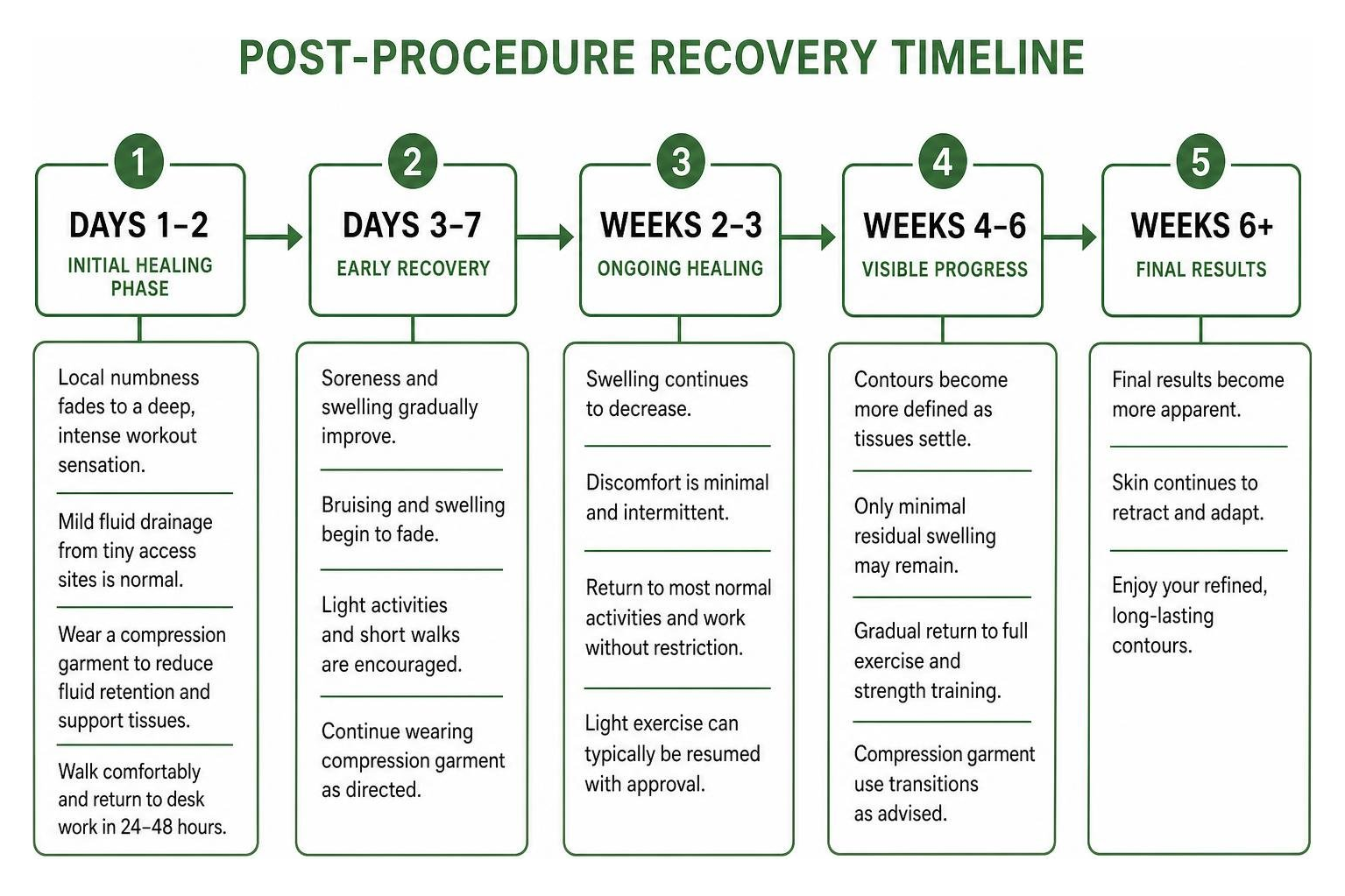
Here is what you can anticipate as your body heals:
Days 1 to 2: The Initial Healing Phase
During the first 24 to 48 hours, soreness, swelling, bruising, drainage from small access sites, and temporary numbness may occur. Some appropriately selected patients can return to light activity or desk work within approximately 24 to 48 hours, while others need more time. Compression garment recommendations depend on the treating surgeon’s instructions and the details of the procedure.
Weeks 1 to 2: Resolving Swelling and Resuming Light Routine
Swelling and bruising may begin to improve, although the pace differs among patients. Light daily activities and gentle walking may be appropriate when cleared by the treating surgeon. Compression use and activity restrictions should follow the surgeon’s individualized guidance.
Weeks 3 to 6: Tissue Settling and Early Contours
Residual swelling can continue to change during this period, and visible contour improvements develop progressively as swelling resolves. Exercise restrictions and the return to moderate activity vary according to the procedure and individual recovery, so surgeon guidance remains important.
Months 3 to 6: Final Refined Profile
Contour maturation may continue for several months or longer as swelling resolves and tissues settle. Skin does not always contract sufficiently after fat removal; depending on skin quality and goals, additional skin-tightening or excisional treatment may sometimes be appropriate.
For an in-depth, day-by-day walkthrough of the healing journey for midsection procedures, review our guide on Abdominal Liposuction Recovery And Results Explained Step By Step.
Cost Considerations and Choosing a Qualified Provider in Fairfield County
When researching body sculpting investments, understanding what influences total pricing is essential. Costs for contouring procedures in Fairfield County vary depending on several practical factors:
- Number of Anatomic Zones: Treating a single focused area (such as the submental chin) requires different clinical time and resources than comprehensive multi-zone sculpting (such as the abdomen, flanks, and lower back combined).
- Volume of Adipose Tissue: The volume of fat removal and the complexity of the treatment area directly influence surgical duration.
- Surgical Facility and Anesthesia Fees: Traditional procedures in hospital settings often include separate operating room fees, anesthesiologist hourly rates, and extensive recovery room costs. Physician-led awake procedures performed in a clinical suite may involve different facility and anesthesia-related costs than hospital-based procedures; total costs vary by the treatment plan and setting.
- Surgeon Expertise: Advanced technical artistry, specialized awake contouring experience, and personalized surgical care represent the primary value in your investment.
Cosmetic liposuction is generally not covered by health insurance. Coverage for medically necessary procedures depends on the diagnosis, insurer, and policy. However, flexible medical financing options and structured payment plans are widely available to help make treatment plans accessible.
Selecting the right surgeon is the most important decision in your journey. During your consultation, evaluate the surgeon’s plastic surgery board certification and credentials, relevant body-contouring experience, applicable facility accreditation, anesthesia and emergency protocols, and before-and-after examples. Discuss the proposed technique, recovery expectations, and whether an awake approach is appropriate for your individual needs. For additional insights on procedure options and techniques, browse our tag/liposuction resources.
Frequently Asked Questions About Liposuction in Stamford
How much does liposuction cost near Stamford CT and does insurance cover it?
Pricing varies based on the specific body areas treated, the overall volume of fat to be removed, and individual anatomical complexity. Cosmetic liposuction is generally not covered by health insurance. Coverage for medically necessary procedures depends on the diagnosis, insurer, and policy. Transparent, all-inclusive quotes and medical financing plans help patients plan their investments clearly.
What is the typical recovery time after awake liposuction?
Some appropriately selected patients return to light activities or desk work within approximately 24 to 48 hours after an awake procedure. Swelling, bruising, soreness, drainage, and temporary numbness may occur, and the pace of recovery varies. Activity and exercise restrictions should follow the treating surgeon’s guidance for the procedure and individual recovery.
Are fat reduction results permanent?
Fat cells physically removed during liposuction are not restored as the same cells. However, remaining fat cells can enlarge with weight gain, and adipose tissue can undergo longer-term biological changes. Maintaining a relatively stable weight generally helps preserve the resulting contour.
Conclusion
Choosing to reshape your silhouette with modern fat reduction is an empowering step toward feeling your absolute best. NovoSculpt’s physician-led, minimally invasive awake contouring approach uses local anesthesia rather than general anesthesia for appropriately selected patients. It provides direct fat removal while recognizing that every procedure involves individualized surgical, anesthetic, recovery, and contour considerations.
NovoSculpt has one physical location in Cos Cob/Greenwich, Connecticut. It serves patients from Greenwich, Fairfield County, Connecticut, and nearby Westchester County, New York, but does not have offices or physical locations in surrounding towns. If you live in Stamford or surrounding communities, our specialized practice is just a short drive away.
Ready to take the next step toward a sculpted, confident profile? Book a Body Contouring Consultation with our dedicated clinical team to explore your custom awake body-sculpting plan today.
Written by: Roberto Magana, BSc, MBA — CEO, NovoSculpt
Last Updated: October 14, 2026
