
Can Fat Come Back After Liposuction? The Short Answer
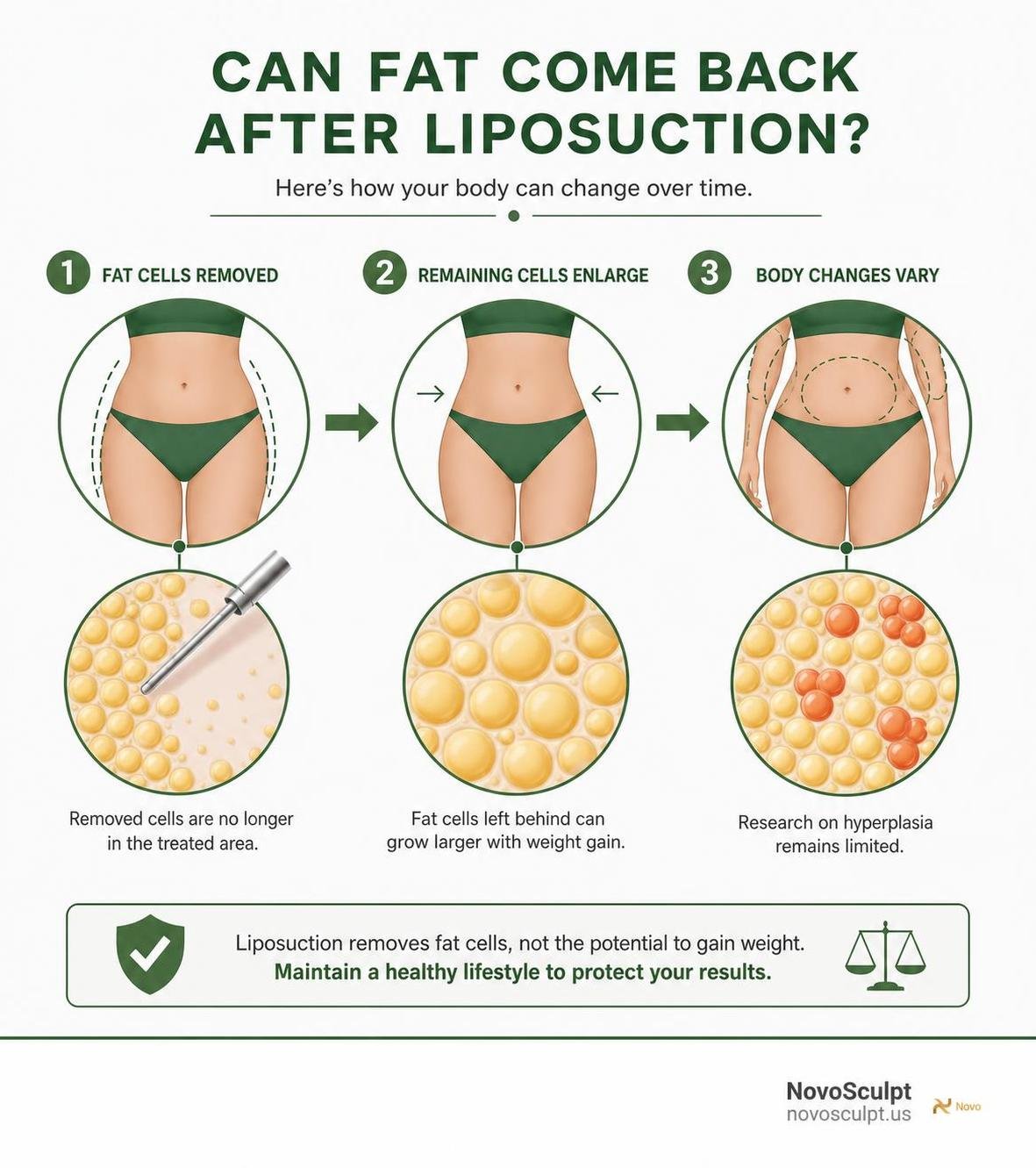
Fat cells removed by liposuction have been removed from the treated area, but liposuction does not prevent future weight gain. Remaining fat cells can enlarge, and meaningful changes in weight can alter the appearance of treated and untreated areas. Maintaining a relatively stable weight generally helps preserve the contour achieved with treatment.
Liposuction is designed for body contouring and localized subcutaneous fat reduction, not for treating obesity or producing general weight loss. Subcutaneous fat lies beneath the skin and is accessible to liposuction. It is different from visceral fat, which surrounds internal abdominal organs and is not removed with liposuction.
NovoSculpt is a proprietary, minimally invasive approach to directly removing localized subcutaneous fat while the patient is awake under local anesthesia, without general anesthesia. Although its approach differs from some conventional liposuction techniques, the same biological principles apply: remaining fat cells can enlarge with weight gain, and maintaining a relatively stable weight can help preserve contour changes over time.
Written by: Roberto Magana, BSc, MBA — CEO, NovoSculpt
Last Updated: October 14, 2026
Introduction
Liposuction can create a more balanced contour by removing localized deposits of subcutaneous fat. It does not lock a person’s body weight or body composition in place. After treatment, remaining fat cells may enlarge with weight gain, and changes in skin, muscle, hormones, aging, and overall body composition can also affect the way an area looks.
This distinction matters because a smaller number of fat cells in a treated area does not make that area immune to future change. The goal of liposuction is contour improvement, not a substitute for nutrition, physical activity, medical weight management, or treatment for obesity.
The sections below explain what is known about fat-cell behavior, what research on post-liposuction fat distribution has found, and where the evidence remains limited.
Can Fat Come Back After Liposuction? The Science of Fat Cells
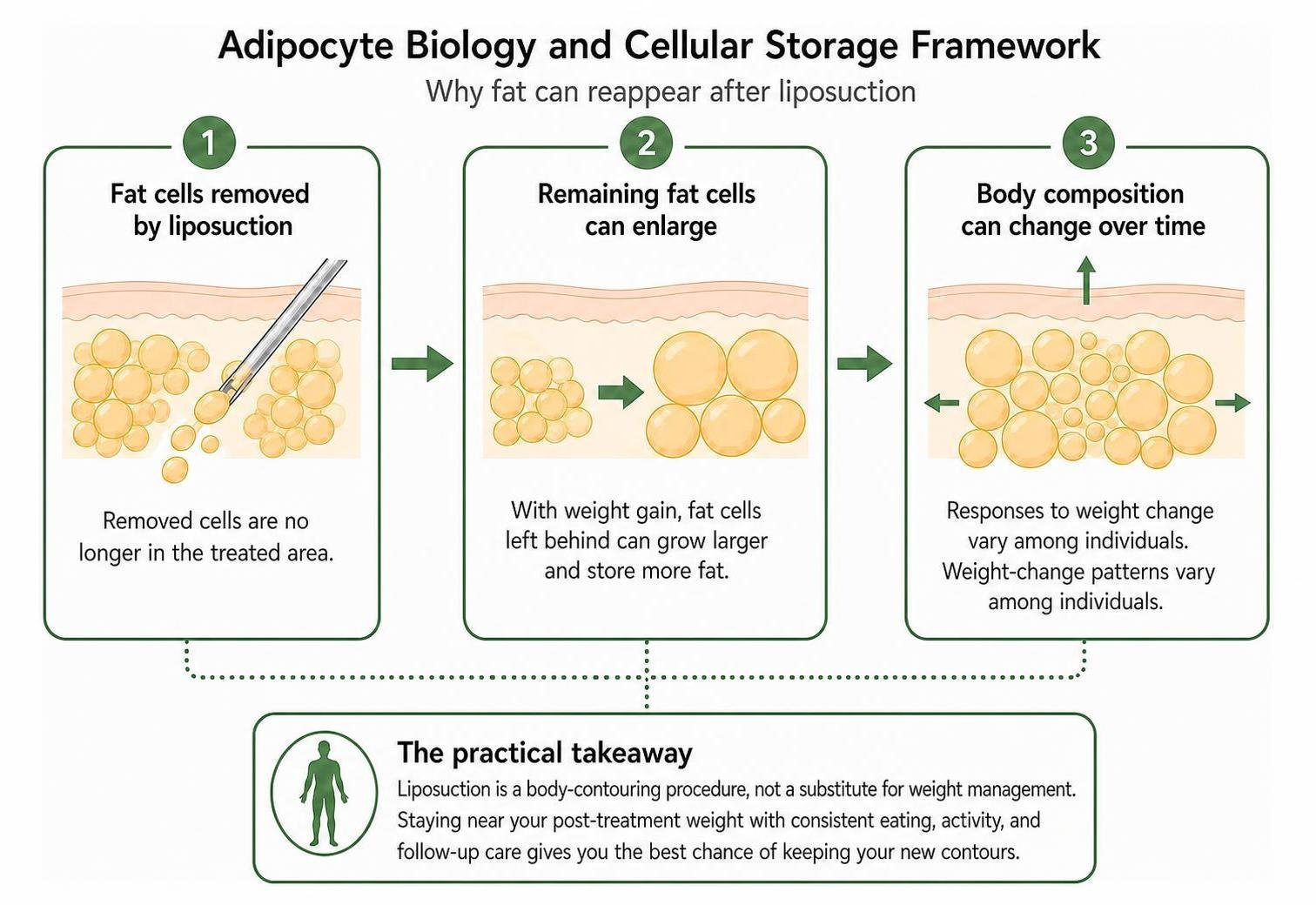
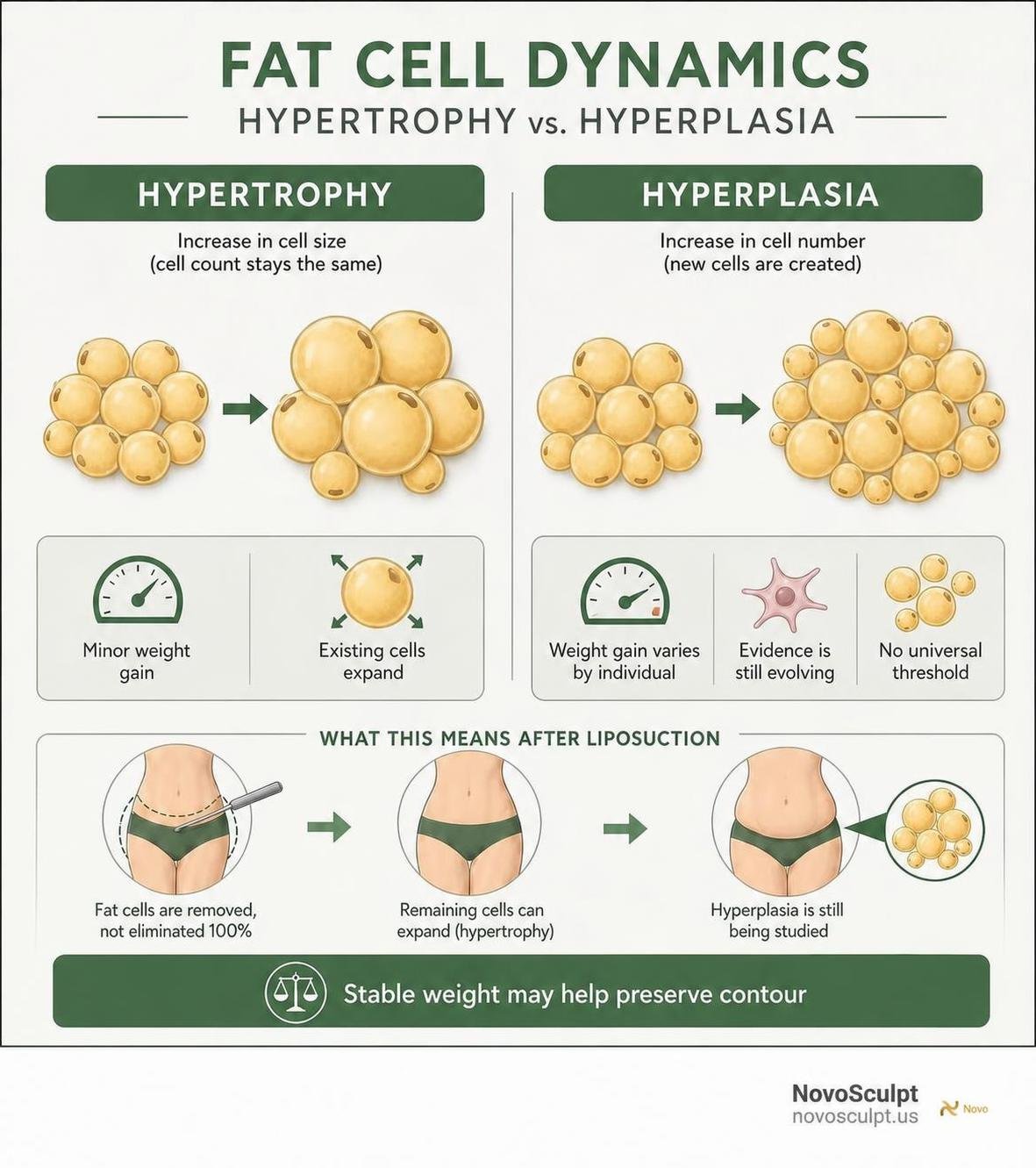
Liposuction removes fat cells from the specific subcutaneous layer that is treated, but it does not prevent the remaining cells from storing fat later. An adipocyte is a fat cell. When body weight rises, existing adipocytes can enlarge, a process called hypertrophy. When weight falls, they can shrink.
A cannula is the narrow surgical instrument used to loosen and remove subcutaneous fat during liposuction. Because a safe procedure leaves a layer of tissue beneath the skin, some adipocytes remain in a treated area. Those cells can still enlarge if body weight increases.
Researchers also use the term hyperplasia to describe an increase in the number of fat cells. Human fat tissue can change over time, but current evidence does not support using a single amount of weight gain as a universal threshold for predicting new fat-cell formation or contour change after liposuction.
Liposuction does not remove visceral fat, the fat located deeper in the abdomen around internal organs. It is therefore not a treatment for visceral-fat reduction, obesity, or the health risks associated with excess body weight. NovoSculpt discusses this distinction further in body contouring is not weight loss.
How Can Fat Come Back After Liposuction If Cells Are Removed?
Fat cells physically removed during liposuction are not restored as the same cells. However, remaining fat cells can enlarge with weight gain, and adipose tissue can undergo longer-term biological changes. The degree of change varies with the amount of fat removed, the person’s weight change, skin quality, anatomy, and other individual factors.
The American Society of Plastic Surgeons explains that cells removed by liposuction are no longer present in the treated area but that weight gain can affect the result because remaining fat cells can enlarge. See its patient-education overview: Can fat return after liposuction?.
Minor Weight Gain vs. Larger Body-Composition Changes
There is no evidence-based cutoff that predicts the same outcome for every patient. Smaller weight fluctuations may have little visible effect for some people, while more substantial or sustained weight gain can soften a contour change. The pattern is not identical across patients or body areas. The American Society of Plastic Surgeons overview of fat return after liposuction offers additional patient education. During healing, swelling can also affect early appearance; NovoSculpt’s abdominal liposuction recovery and results overview provides procedure-specific context, while individual recovery varies.
For the most reliable expectations, patients should discuss their current weight stability, treatment goals, medical history, skin quality, and the amount and location of fat with a qualified treating physician.
Fat Redistribution: What Research Can and Cannot Tell Us
Weight gain after liposuction does not follow one automatic or predictable pattern. Research has examined compensatory fat accumulation and changes in body-fat distribution after liposuction, but individual outcomes vary. It is not accurate to say that excess calories automatically move to untreated areas.
Changes in body shape after treatment may reflect overall weight change, the remaining fat cells in treated areas, untreated fat deposits, skin quality, and individual biology. There is not good evidence that cannula-related tissue trauma or scar formation determines where future fat will be stored, so that mechanism should not be used to predict a patient’s result.
What Did the 2011 Randomized Trial Find?
A small 2011 randomized trial found that, in the participants studied, fat distribution changed over one year after small-volume liposuction. The study followed 32 non-obese women randomized to receive liposuction of the lower abdomen, hips, or thighs or to a control group. At one year, total body-fat percentage no longer differed significantly between groups. The treated thigh region remained reduced, while adipose tissue reaccumulated in the abdominal region.
The original peer-reviewed report is available through PubMed: Fat redistribution following suction lipectomy: defense of body fat and patterns of restoration.
This study is useful, but it should not be generalized to every liposuction patient. It involved a small, specific population, limited treatment areas, and one year of follow-up. It does not establish that every patient will regain the same amount of fat or develop the same distribution pattern after liposuction.
| What the study supports | What remains uncertain |
|---|---|
| Fat distribution can change after small-volume liposuction in some patients. | Whether the same pattern occurs across different ages, body types, procedures, treatment volumes, and long-term follow-up. |
| The treated thighs remained smaller at one year in that study. | How a specific individual’s weight gain will affect treated and untreated areas. |
| Fat distribution differed by body site in this study. | A universal biological mechanism or clinical prediction rule for fat redistribution. |
Can Unevenness Occur After Liposuction?
Yes. Contour irregularities, asymmetry, skin laxity, and changes with weight fluctuation can affect how a treated area looks. Evaluation should be individualized. Depending on the cause and severity, options may include observation, nonsurgical management, or a carefully planned revision procedure.
A consultation should assess the original treatment, skin quality, scar tissue, current weight stability, anatomy, and goals before recommending any corrective approach. Liposuction and other minimally invasive fat-removal procedures also carry potential risks, including swelling, contour irregularities, infection, fluid collections, and other procedure-specific complications; risk and recovery vary by treatment and patient.
How to Maintain Your Liposuction Results Long-Term
The most practical way to help preserve a contour change is to maintain a relatively stable weight with sustainable habits and appropriate medical guidance. Liposuction changes localized subcutaneous fat; it does not replace a long-term approach to nutrition, activity, sleep, and overall health.
There is no universal meal plan, hydration target, exercise prescription, or weight-change number that applies to every person after liposuction. Patients can also review NovoSculpt’s guidance on maintaining results after lower body contouring. Recovery instructions and activity progression should come from the treating surgeon because they depend on the treatment area, procedure extent, health history, and healing.
Habits That Support Stable Results
- Choose sustainable nutrition. A balanced eating pattern that a patient can maintain is generally more useful than restrictive short-term dieting.
- Return to activity as medically advised. Regular physical activity supports overall health and weight stability, but the timing and intensity after a procedure should follow surgeon guidance.
- Attend follow-up visits. Follow-up care allows the treating team to monitor healing, address questions, and give individualized recommendations.
- Seek care when weight or health changes are difficult to manage. A primary-care clinician, registered dietitian, or other qualified professional can help when appropriate.
These steps cannot guarantee a particular result, but they support the weight stability that is generally associated with maintaining body-contouring outcomes.
Frequently Asked Questions About Fat Return
Where Can Fat Change After Liposuction?
Future fat accumulation can affect both treated and untreated areas, but the pattern varies from person to person. Remaining fat cells in a treated area can enlarge with weight gain. Untreated areas may also change, and no study can precisely predict the distribution for an individual patient.
Liposuction targets accessible subcutaneous fat beneath the skin. It does not remove visceral fat, which is located deeper in the abdomen around internal organs.
Does the Body Naturally Try to Replace Removed Fat?
There is no established, universal “replacement” response that predicts how every body will react after liposuction. Some research has explored changes in body-fat distribution after treatment, but it does not prove that liposuction causes a leptin-driven increase in appetite or metabolic slowing that restores removed fat in every patient.
For patients concerned about appetite, weight changes, or metabolic health, an individualized discussion with a treating physician or primary-care clinician is more useful than assuming one biological response.
Can Pregnancy Change Liposuction Results?
Yes. Pregnancy can change body shape and may affect a previous contouring result. Hormonal changes, weight changes, and stretching of the skin and abdominal wall can alter both treated and untreated areas. People planning future pregnancies may want to discuss timing and expectations with their physician before elective body-contouring treatment.
Is NovoSculpt Right for Every Patient?
No. Treatment choice should be individualized. NovoSculpt offers physician-led, minimally invasive body contouring performed while the patient is awake under local anesthesia, without general anesthesia. Suitability and treatment planning depend on anatomy, medical history, skin quality, the amount and location of fat, goals, anesthesia preferences, and the treating physician’s judgment.
Conclusion
In short, liposuction changes a treated area by removing subcutaneous fat cells, yet it cannot prevent later weight gain or other body-composition changes. Remaining cells can enlarge, and substantial weight changes may alter treated and untreated areas. A relatively stable weight generally supports maintenance of the resulting contour.
Liposuction and NovoSculpt procedures are intended for body contouring and localized subcutaneous fat reduction, not for treatment of obesity or general weight loss. They do not remove visceral fat around the internal abdominal organs.
NovoSculpt provides physician-led, minimally invasive awake body contouring and fat-removal procedures under local anesthesia. Treatment plans, recovery, discomfort, risks, and outcomes vary by patient and by the extent of treatment. NovoSculpt has one physical location in Cos Cob/Greenwich, Connecticut, and welcomes patients visiting from Greenwich, Fairfield County, and neighboring Westchester County, New York.
To discuss whether awake body contouring may fit your goals and medical history, review the NovoSculpt FAQs and Consultation Information or arrange an individualized consultation with the surgical team.
