
Breast Lift vs Breast Augmentation: Key Differences
When comparing breast lift vs breast augmentation, start with the concern you want to change: breast position, volume, or both. A breast lift (mastopexy) reshapes and elevates breast tissue and skin. Breast augmentation adds volume, either with a breast implant or, for appropriately selected patients, with autologous fat transfer.
Quick Answer: A breast lift primarily addresses breast position, sagging, excess skin, and nipple position, while breast augmentation primarily adds volume. Augmentation can use breast implants or, for appropriate patients, autologous fat transfer. Patients with both significant sagging and volume loss may need a lift combined with augmentation. The appropriate approach depends on anatomy, tissue quality, desired volume, and individual goals.
| Consideration | Breast Lift (Mastopexy) | Implant Augmentation | Fat-Transfer Breast Augmentation | Lift + Augmentation |
|---|---|---|---|---|
| Primary goal | Reshape and elevate the breast | Add volume with a medical device | Add volume with the patient’s own fat | Address both position and volume |
| Adds volume? | Not primarily | Yes | Yes, usually modest/proportional | Yes, when augmentation is included |
| Addresses significant sagging? | Yes, when clinically appropriate | Not by itself | Not by itself | Yes, when lift is included |
| Can reposition nipple/areola? | Yes, when needed | No | No | Yes, when lift is included |
| Uses a breast implant? | No | Yes | No | May use an implant or fat transfer |
| Uses patient’s own fat? | No | No | Yes | Sometimes |
| Requires donor fat? | No | No | Yes | Only when fat transfer is used |
| Scarring/access sites | Breast incisions vary by plan | Breast incision plus implant pocket | Small donor-area and breast access sites | Includes lift incisions plus augmentation access |
| Relative volume potential | Does not primarily add volume | Often allows greater, more selectable volume | Usually more limited by donor fat and tissue characteristics | Depends on the selected augmentation method |
| Key limitations | Does not primarily restore lost volume | Does not remove substantial excess skin or directly lift descended tissue | Retention varies; large volume changes may not be feasible | May be combined or staged based on anatomy and safety |
| Important considerations | Scarring, sensation changes, healing, recurrent laxity over time | Monitoring, capsular contracture, rupture, malposition, possible future surgery | Resorption, fat necrosis, oil cysts, calcifications, asymmetry, donor-site considerations | Combines considerations of both procedures |
| Anesthesia and recovery | Depend on surgical plan and individual factors | Depend on treatment plan and individual factors | Depend on treatment plan, donor areas, and individual factors | Often more involved; timing and recovery vary |
A lift changes the skin envelope, tissue shape, and breast position. Augmentation changes volume. That distinction matters because adding volume does not automatically correct stretched skin, substantial breast descent, or a low nipple position. The American Society of Plastic Surgeons also distinguishes augmentation from lifting: the procedures may be performed separately or together, depending on the patient’s goals and anatomy. Learn more about the procedural differences.
How Is Candidacy Evaluated?
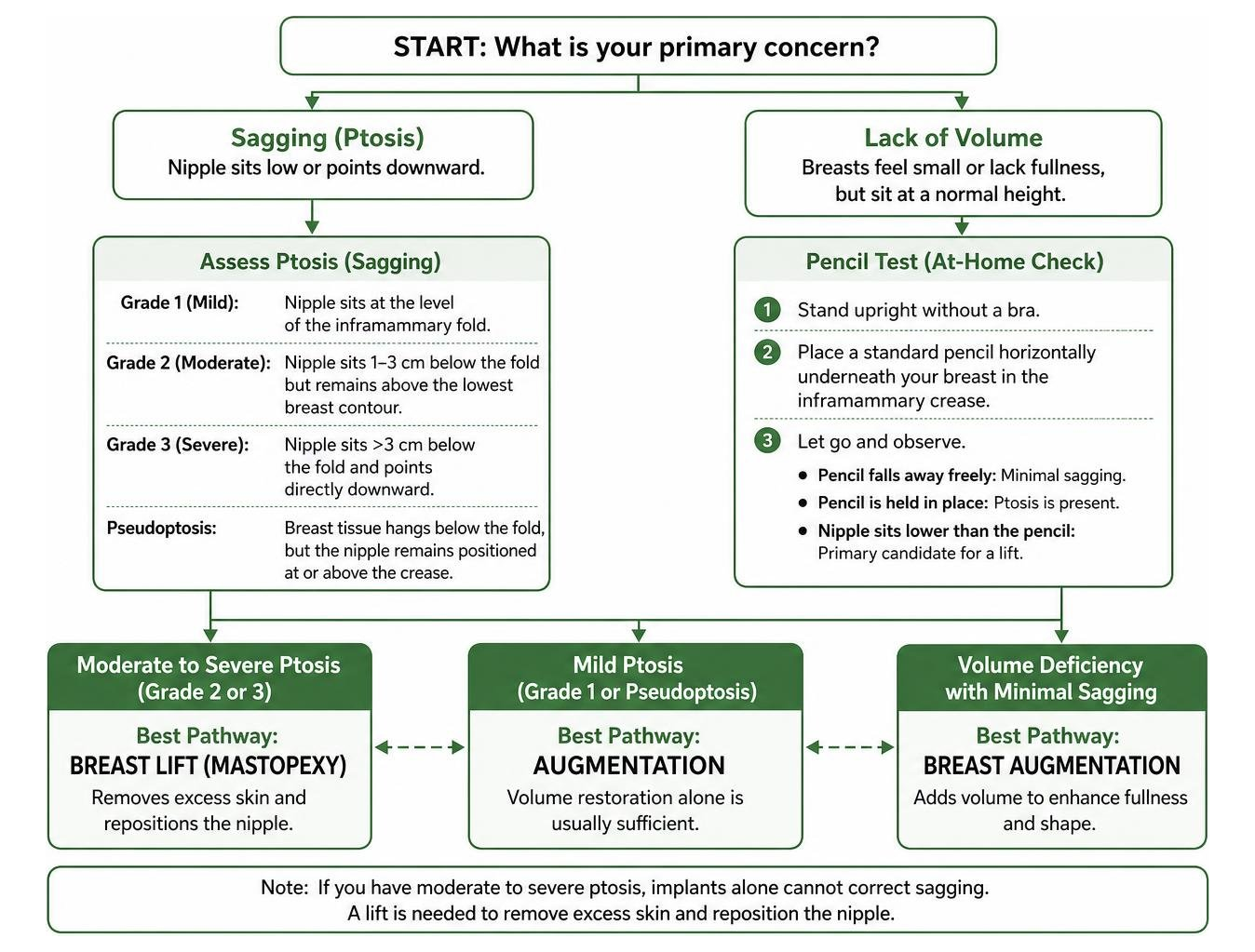
At-home observations can help you describe what you notice, but they cannot diagnose ptosis or determine which procedure you need. The commonly discussed “pencil test” is not a diagnostic test and should not be used to self-select surgery.
A clinician evaluates the nipple-areola complex in relation to the inframammary fold, the amount and distribution of breast tissue, skin elasticity, breast shape, asymmetry, chest-wall proportions, and your desired volume. These factors help determine whether the central issue is position, volume, or both.
Can Implants Alone Correct Sagging?
Implants primarily add volume. They do not directly remove excess skin or reposition substantially descended breast tissue. In selected patients with mild deflation or limited ptosis, implant augmentation alone may create an appearance the patient finds satisfactory. When significant ptosis, excess skin, or a low nipple position is present, a lift may be needed to address those anatomical concerns.
Using a larger implant is not a reliable substitute for correcting significant skin excess or breast descent. Tissue stretching, implant malposition, and bottoming out are potential considerations to discuss—not inevitable outcomes. A personalized examination is the appropriate way to decide whether augmentation alone, a lift, or a combined approach aligns with the desired result.
What Are the Surgical and Non-Implant Volume Options?
How Does a Breast Lift Work?
A breast lift, also called mastopexy, reshapes and elevates existing breast tissue while removing or rearranging skin and tissue according to the surgical plan. It may also reposition the nipple-areola complex. A lift does not primarily exist to add volume, although the breast can look more compact after reshaping.
Incision patterns are selected based on the degree of ptosis, amount of excess skin, breast size, tissue quality, nipple position, desired reshaping, and surgeon planning. Common approaches include:
- Periareolar: An incision around the areola that may be considered for limited reshaping or areola adjustment.
- Vertical (lollipop): Incisions around the areola and vertically toward the breast crease; this pattern can allow more reshaping when appropriate.
- Anchor (inverted-T): Adds an incision along the breast crease and may be used when the surgical plan requires more skin removal or reshaping.
Every mastopexy incision produces a scar. Scar appearance and healing vary, and the appropriate incision pattern is based on anatomy and treatment goals rather than a single “best” technique.
What Does Implant Augmentation Involve?
Implant augmentation adds volume by placing a saline or silicone gel-filled breast implant in a surgically created pocket. It can provide meaningful volume enhancement and allows more control over implant size and profile than fat transfer generally can. The FDA states that saline-filled implants are approved for augmentation in patients age 18 and older, while silicone gel-filled implants are approved for augmentation in patients age 22 and older. Review FDA implant types and age indications.
Implants can be an appropriate choice for people seeking more substantial volume or highly specific size and profile selection. They also carry implant-specific considerations, including monitoring, capsular contracture, rupture, malposition, and the possibility of future revision or replacement surgery. Breast implants are not considered lifetime devices, and the likelihood of complications can increase over time. FDA guidance on implant risks and complications includes information on these issues and on breast implant-associated anaplastic large cell lymphoma (BIA-ALCL), a rare cancer of the immune system associated more often with textured implant surfaces.
Can Breast Augmentation Be Performed Without Implants?
Yes. For appropriately selected patients, autologous fat transfer can add breast volume using the patient’s own harvested fat rather than a breast implant. This option is often discussed as breast augmentation without implants, breast fat transfer, natural breast augmentation, or fat grafting to breasts.
The general process involves four steps:
- Fat is harvested from an appropriate donor area.
- The harvested fat is processed or prepared according to the treatment technique.
- Selected fat is transferred to the breasts to enhance volume and contour.
- During healing, some transferred fat establishes a blood supply and persists long term, while some may be naturally resorbed.
Final retained volume varies among patients. Fat transfer is typically most relevant to people who want modest or proportional volume enhancement, prefer not to have breast implants, have appropriate donor fat, and understand that an additional treatment may sometimes be considered. Published research reviews note that fat-graft retention varies and that complications can include fat necrosis, oil cysts, and calcifications. See a peer-reviewed review of breast fat grafting.
NovoGain: Fat Transfer With Donor-Area Contouring
At NovoSculpt, NovoGain is an autologous fat-transfer approach designed for appropriate patients seeking breast-volume enhancement without synthetic breast implants. Fat is harvested from selected donor areas during body contouring and transferred to the breasts according to the individualized treatment plan.
For an appropriate patient, planning considers two connected aesthetic goals: donor-area contour and recipient breast volume and shape. In other words, donor-area contouring is not treated merely as a source of fat; the plan evaluates where localized fat removal may improve contour and how selected harvested fat may be used to enhance breast shape and volume.
NovoGain is designed to be performed awake under local anesthesia for appropriately selected patients. An awake local-anesthesia approach avoids general anesthesia and therefore avoids the risks, physiologic effects, and recovery specifically associated with general anesthesia itself. It does not make the procedure risk-free. Recovery varies with the treatment plan, donor areas, transferred volume, individual healing, and other clinical factors. Explore NovoGain as a breast-implant alternative.
Fat Transfer vs Implants vs a Breast Lift: Benefits, Tradeoffs, and Risks
Autologous fat transfer and implant augmentation both add volume, but they do so differently. A breast lift serves a different purpose: it addresses breast position, skin excess, and reshaping.
What Are the Advantages and Limits of Fat-Transfer Breast Augmentation?
For appropriate patients, fat transfer can offer several meaningful differences:
- No synthetic breast implant is placed.
- The procedure uses the patient’s own tissue.
- Donor-area body contouring can be planned alongside breast-volume enhancement.
- It may provide proportional, natural-volume enhancement.
- Implant-specific complications such as implant rupture and capsular contracture are not applicable to the transferred fat itself because no breast implant is present.
- There is no breast implant that ages or fails and therefore no future implant replacement solely for that reason.
Those advantages do not make fat transfer universally superior or risk-free. Important considerations include variable fat retention or resorption, fat necrosis, oil cysts, calcifications, asymmetry, infection, contour irregularity, donor-site concerns, limited achievable volume, and the possibility of additional treatment. The American Society of Plastic Surgeons provides patient safety information on fat-transfer breast augmentation.
Can Fat Transfer Lift Sagging Breasts?
No—fat transfer adds volume but does not substitute for a breast lift when significant excess skin, ptosis, or nipple-position concerns require tissue elevation. A patient with volume loss and relatively favorable breast position may potentially consider augmentation alone, including fat transfer. A patient with significant breast descent or excess skin may need mastopexy. When both volume loss and ptosis are present, a lift with augmentation may be considered.
When Is a Lift Combined With Augmentation?
Patients with both significant ptosis and volume deficiency may be candidates for augmentation-mastopexy. The augmentation portion may use an implant or autologous fat, depending on the treatment plan. Combined treatment may be performed in one operation or staged; the decision depends on anatomy, tissue quality, vascular considerations, desired volume, healing factors, and clinical judgment.
A combined plan requires careful evaluation because lifting and adding volume can place competing demands on the tissue envelope. The safest and most appropriate sequence is individualized—not assumed from a photograph, cup-size goal, or at-home test.
What Should You Know About Recovery, Longevity, and Cost?
Recovery varies by procedure, extent of surgery, anesthesia plan, anatomy, healing, activity level, pregnancy, weight changes, aging, tissue quality, and complications. Rather than relying on a fixed return-to-work or exercise timeline, patients should follow their treating clinician’s specific instructions.
Likewise, long-term changes vary. A lift does not stop aging or future tissue stretching. Fat-transfer retention differs among patients. Implants require ongoing awareness and may require future monitoring or surgery, but there is no universal replacement deadline that applies to every implant.
Cost discussions should distinguish the professional or surgeon fee from the total procedure cost. Total cost may include facility charges, anesthesia when applicable, implants when applicable, garments, medications, testing, follow-up care, geographic market, procedure complexity, and whether procedures are combined or staged. A consultation is the best setting for a patient-specific estimate rather than a generalized national price range.
How Do You Choose Between a Breast Lift, Implants, and Fat Transfer?
Use this framework to prepare for a consultation:
- Identify the primary concern. Is it breast position, loss of volume, asymmetry, skin excess, or a combination?
- Clarify the volume goal. People seeking a modest, proportional change may evaluate fat transfer differently from those seeking substantial volume or highly specific implant sizing.
- Consider breast position and skin quality. Significant ptosis, excess skin, or low nipple position may point toward a lift as part of the plan.
- Consider donor-fat availability. Fat-transfer breast augmentation requires an appropriate donor area and tissue characteristics that support the proposed plan.
- Discuss tradeoffs openly. Ask about scars, anesthesia, recovery, monitoring, potential complications, revision possibilities, and whether combined or staged treatment is appropriate.
- Evaluate the treatment setting and follow-up plan. Look for formal specialty training in plastic surgery, procedure-specific experience, state licensure, hospital privileges where relevant, an appropriately accredited procedural facility, transparent risks and alternatives, complication preparedness, and follow-up care.
A consultation should translate your goals into an anatomy-based recommendation. It should not assume that implants are the only way to augment breasts—or that fat transfer can replace a lift when elevation is needed.
Frequently Asked Questions About Breast Lift vs Breast Augmentation
What is the main difference between a breast lift and breast augmentation?
A breast lift primarily reshapes and elevates breast tissue, addresses excess skin, and may reposition the nipple-areola complex. Breast augmentation primarily adds volume. Augmentation may use breast implants or, for appropriately selected patients, autologous fat transfer.
How do I know if I need a breast lift or breast augmentation?
Nipple position relative to the inframammary fold can provide useful information, but it cannot determine treatment by itself. If breast tissue or the nipple-areola complex has descended significantly, a lift may be needed because augmentation primarily adds volume rather than removing excess skin or repositioning substantially descended tissue. A consultation is necessary to evaluate breast shape, skin quality, nipple position, volume goals, and asymmetry.
Can breast augmentation be done without implants?
Yes. Fat-transfer breast augmentation uses fat harvested from the patient’s own donor areas rather than a breast implant. It is typically considered for patients seeking modest or proportional volume enhancement who have suitable donor fat and realistic expectations about variable retention.
Can fat transfer lift sagging breasts?
Fat transfer adds volume; it does not remove substantial excess skin or elevate significantly descended breast tissue or nipples. When those concerns are present, mastopexy may be needed, with or without augmentation.
Is fat-transfer breast augmentation permanent?
It should not be described simply as permanent. Some transferred fat can establish a blood supply and persist long term, while some may be resorbed. The final retained volume varies, and some patients may consider additional treatment.
How much larger can breasts become with fat transfer?
The possible change is individualized and is generally more modest than what implants can provide. Donor-fat availability, breast tissue characteristics, the planned transfer volume, and fat retention all affect the result. A clinician can discuss what is realistic for your anatomy.
Do I need enough body fat for fat-transfer breast augmentation?
Yes. Because the procedure uses your own harvested fat, appropriate donor-fat availability is an important part of candidacy. The donor areas and desired breast-volume change are evaluated together.
Can fat be removed from my stomach and transferred to my breasts?
Potentially. The abdomen may be one possible donor area, but the selection of donor areas depends on individual anatomy and the treatment plan. With NovoGain, planning considers both donor-area contouring and recipient breast volume and shape.
Can I have a breast lift and fat transfer at the same time?
In some cases, a lift and fat transfer may be considered together; in others, staging may be more appropriate. The decision depends on factors such as ptosis, skin quality, vascular considerations, desired volume, and surgeon judgment.
What happens to breast fat that does not survive after transfer?
Some transferred fat may be naturally resorbed during healing. This contributes to variability in final volume. Potential changes such as fat necrosis, oil cysts, or calcifications should be discussed during informed consent and evaluated appropriately if they occur.
Does fat-transfer breast augmentation require general anesthesia?
Anesthesia depends on the treatment plan and patient factors. At NovoSculpt, NovoGain is designed to be performed awake under local anesthesia for appropriately selected patients. This avoids general anesthesia itself but does not eliminate procedural risks or make recovery identical for every patient.
Are breast implants or fat transfer better for natural-looking volume?
Neither option is universally better. Implants may suit patients seeking greater or more specifically selectable volume. Fat transfer may suit appropriate patients who want proportional enhancement without a synthetic implant and have sufficient donor fat. The best choice depends on anatomy, priorities, and a balanced discussion of risks and tradeoffs.
Will a breast lift make my breasts smaller?
A breast lift primarily reshapes and elevates existing breast tissue while removing excess skin. Depending on the surgical plan, tissue may be rearranged and, in some cases, removed. A lift does not primarily exist to add volume, so some patients perceive the breast as more compact after reshaping. If additional volume is desired, augmentation may be considered separately or in combination.
Conclusion: Match the Procedure to the Concern
Choosing between a breast lift vs breast augmentation begins with identifying the concern you actually want to change. A lift primarily addresses breast position and excess skin, while augmentation adds volume. For patients who want volume without a breast implant and have suitable donor fat, autologous fat transfer provides another option. Patients with significant sagging may still need a lift, with or without augmentation.
At NovoSculpt in Cos Cob/Greenwich, Connecticut, specialty-trained, fully accredited plastic surgeons who graduated from U.S. universities offer NovoGain for appropriately selected patients seeking breast-volume enhancement using their own fat. Treatment planning can combine donor-area body contouring with individualized fat transfer while the patient remains awake under local anesthesia when appropriate.
If you are considering breast augmentation in Greenwich CT, fat-transfer breast augmentation in Greenwich CT, or a breast lift consultation from Fairfield County or nearby Westchester County, schedule a complimentary NovoSculpt consultation to discuss your anatomy, goals, risks, and appropriate treatment options.
