
Arm Lift Cost: Reference Pricing and Procedure Options
Written by Roberto Magana, BSc, MBA, CEO, NovoSculpt
Arm lift cost varies because the phrase can describe very different treatment plans. A traditional brachioplasty is designed primarily to remove substantial loose upper-arm skin; upper-arm liposuction or awake arm contouring may be considered when localized subcutaneous fat is the main concern and skin elasticity is relatively good. For that reason, a quote for an arm lift should never be treated as a universal price.
The American Society of Plastic Surgeons reports an average surgeon’s fee for arm lift surgery, but that figure is not the same as a patient’s complete out-of-pocket cost. Total cost can also include anesthesia, facility resources, preoperative testing, garments, prescriptions, and follow-up care. In many U.S. markets, total reference estimates for brachioplasty commonly fall in the mid-thousands and can exceed $10,000 when the procedure is more extensive or combined with liposuction. See the current ASPS arm lift cost information for the distinction between a professional fee and a complete surgical bill.
| Procedure or Approach | Typical Reference Cost / Range* | What It Primarily Addresses | Important Cost Considerations |
|---|---|---|---|
| Mini brachioplasty | Often about $5,000-$8,000 | Limited skin laxity near the underarm in selected patients | Incision design, anesthesia, facility setting, and whether liposuction is added |
| Standard brachioplasty | Often about $5,000-$12,000+ | More substantial loose skin along the upper arm | Surgeon fee, anesthesia, facility, scar length, and postoperative care |
| Extended brachioplasty | Often about $8,000-$15,000+ | Excess skin extending toward the axilla or lateral chest, often after major weight loss | Greater treatment extent, operating time, facility needs, and recovery support |
| Upper-arm liposuction | Often about $3,000-$8,000 | Selected localized fat when skin elasticity is favorable | Number of areas, anesthesia plan, setting, and whether skin management is also needed |
| Brachioplasty plus liposuction | Often about $7,000-$14,000+ | Both fat and clinically significant skin laxity | Combined-procedure complexity and whether all facility/anesthesia costs are included |
| Awake arm contouring at NovoSculpt | Varies by individualized treatment plan | Selected localized upper-arm fat in appropriately selected patients | Treatment extent, anatomy, complementary skin treatment, and follow-up plan |
*These are broad market-reference estimates, not NovoSculpt prices, guaranteed quotes, or universal national averages. The table synthesizes total-price market references from CostHelper and patient-reported RealSelf arm lift cost data, alongside ASPS professional-fee information. ASPS itself does not publish a universal total-cost range. A consultation and written itemized quote are the only way to determine an individual treatment cost.
Why Arm Lift Prices Vary So Much
Two people searching for an upper arm lift cost may have different underlying concerns:
- Localized subcutaneous fat: Upper-arm liposuction or physician-led awake direct fat removal may be considered when skin quality is favorable.
- Skin laxity: Fat removal alone may not adequately address loose skin; a skin-management strategy or excisional procedure may be more appropriate.
- Both fat and skin laxity: Planning may involve more than one modality, depending on anatomy and goals.
- Substantial hanging skin after major weight loss: Excisional brachioplasty, sometimes extending toward the lateral chest, may provide the degree of skin removal less invasive treatment cannot.
That fat-versus-skin distinction is one of the biggest reasons arm contouring prices differ. It also helps prevent an unrealistic comparison between a full skin-excision procedure and a treatment focused primarily on localized fat.
Brachioplasty Cost by Technique
A mini brachioplasty may use a more limited incision and is generally intended for selected patients with relatively limited skin laxity. A standard brachioplasty commonly uses a longer upper-arm incision to remove more substantial redundant skin. An extended brachioplasty may extend treatment toward the axilla or lateral chest when excess skin reaches beyond the upper arm, which is more common after major weight loss.
The precise incision, operative time, use of drains, and recovery protocol depend on anatomy and the treating surgeon’s approach. Cleveland Clinic’s brachioplasty overview is a useful general resource on the procedure, scars, and recovery considerations.
Awake Arm Contouring and Local-Anesthesia Options
Traditional brachioplasty and awake arm contouring are not interchangeable. For appropriately selected patients whose main concern is localized upper-arm fat rather than substantial hanging skin, NovoSculpt offers physician-led awake fat removal using local tumescent anesthesia and a minimally invasive cannula-based approach. The goal is selective, direct physical removal of localized subcutaneous fat and individualized contouring—not a substitute for excisional brachioplasty when major skin excess is present.
An awake procedure performed entirely under local anesthesia avoids exposure to the risks, physiologic effects, nausea, grogginess, and recovery specifically attributable to general anesthesia itself. It does not make the procedure risk-free or mean local anesthesia is appropriate for every patient or every operation. Treatment candidacy should be determined by an in-person evaluation with specialty-trained, fully accredited plastic surgeons who graduated from U.S. universities.
For readers comparing options in Connecticut, learn more about awake arm contouring and upper-arm fat removal.
What Determines Your Final Arm Lift Cost?
The bottom-line price is usually the sum of several clinical and operational decisions—not one flat surgical fee. Procedure extent, skin laxity, fat distribution, surgeon experience, anesthesia plan, treatment setting, and combined procedures all influence the final estimate.
Anesthesia, Facility, and Surgical Complexity
General anesthesia or deeper sedation may involve a qualified anesthesia professional, monitoring, recovery services, and operating-room or ambulatory-surgery-center resources. An awake, office-based procedure may have a different cost structure because it does not include general anesthesia itself or the same facility workflow. That does not automatically make one option better; the appropriate setting depends on the planned procedure, safety assessment, and patient needs.
When evaluating credentials and safety, ask about specialty training, procedure-specific experience, facility accreditation where relevant, before-and-after examples, complication management, and follow-up care. The ASPS comparison of upper-arm lift and liposuction also reinforces why treatment selection should follow the anatomy rather than the lowest advertised price.
What Should Be Included in an Arm Lift Quote?
Ask for a written, itemized quote and confirm whether it includes:
- Surgeon or professional fee
- Anesthesia and qualified anesthesia professional fees, if applicable
- Operating-room, facility, monitoring, and recovery charges
- Preoperative testing or medical clearance, when required
- Pathology fees, when applicable
- Compression garments
- Prescriptions
- Postoperative visits and the expected follow-up period
- Scar-care products or recommendations
- Revision or touch-up policies
- Additional facility or procedural costs if another treatment or revision is required
This checklist is more useful than assuming a low advertised number reflects the complete cost. It also makes it easier to compare estimates from different practices on an equal basis.
Insurance Coverage and Financing
Brachioplasty performed solely for cosmetic contouring is generally considered elective and is typically paid out of pocket. Coverage may occasionally be considered when excess skin produces documented medical or functional problems—such as recurrent rashes, infections, skin breakdown, ulceration, or functional impairment—and the patient’s plan has applicable medical-necessity criteria.
Requirements vary by insurer and plan. Do not assume every policy requires the same treatment history, weight-stability period, photographs, or clinician documentation. Contact the insurer directly and ask the treating practice what records may be relevant before relying on possible coverage.
Because out-of-pocket payment is common, some patients explore financing. NovoSculpt’s payment-plan information can help patients understand available options. Monthly payments depend on the financed amount, credit approval, lender, promotional terms, APR, and repayment term; financing approval and interest rates are never guaranteed.
Do You Need an Arm Lift, Liposuction, or Both?
| Main Concern | Possible Approach to Discuss | Key Limitation to Understand |
|---|---|---|
| Localized upper-arm fat with relatively good skin elasticity | Upper-arm liposuction or awake direct fat removal may be considered | Fat removal does not guarantee skin tightening |
| Mild-to-moderate skin laxity plus localized fat | Fat removal plus an appropriate skin-management strategy may be considered | The best combination depends on examination findings |
| Substantial hanging or redundant skin | Excisional brachioplasty may be more appropriate | It commonly involves a more visible scar and longer recovery than limited fat removal |
| Major weight-loss skin extending toward the lateral chest | Extended excisional surgery may be considered | Treatment extent and cost can be higher |
This framework is educational, not a diagnosis. An individual examination determines whether the primary issue is fat, skin laxity, or both.
Typical Arm Lift Recovery Milestones and Downtime Costs
Healing should be included in the overall budget. Indirect costs can include time away from work, childcare, transportation, help at home, and a temporary pause in gym or recreational activities.
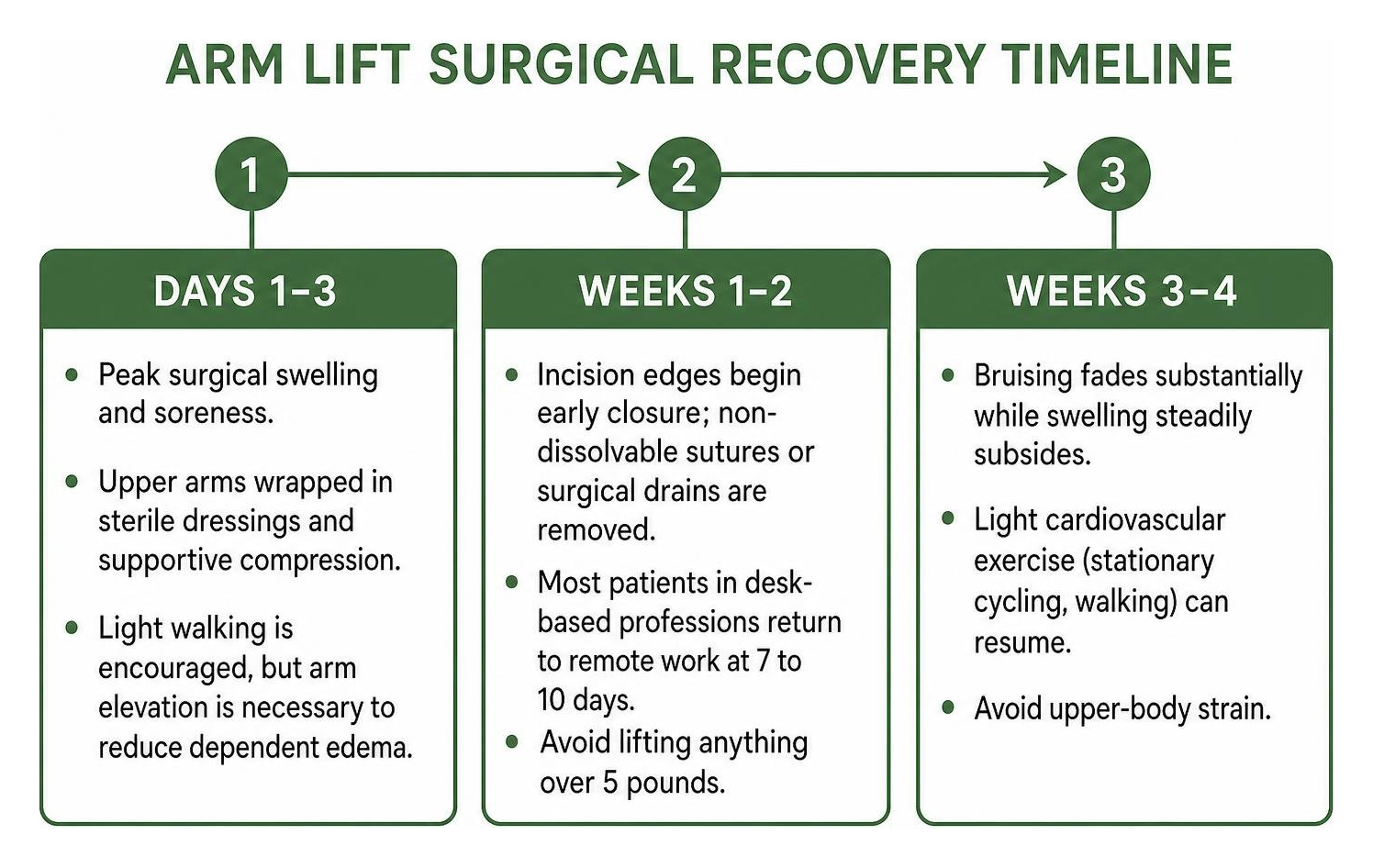
Recovery varies according to the extent of skin excision, whether liposuction is combined, incision length, individual healing, and the surgeon’s postoperative protocol. Typical arm lift recovery milestones may include:
- First several days: Swelling, soreness, bruising, dressings, and compression are common. Patients are generally encouraged to follow their specific movement and arm-elevation instructions.
- About 1-2 weeks: Many patients with desk-based work may be able to return with restrictions, but lifting, repetitive reaching, and driving may still be limited.
- Weeks 3-6: Swelling and bruising often continue to improve. Light activity may progress only when cleared, while strenuous upper-body activity remains restricted for longer.
- Around 6-8 weeks or later: Many patients are gradually cleared for heavier lifting and more vigorous exercise, depending on healing and the procedure performed.
- Several months: Scar maturation and residual swelling can continue to evolve over months.
Awake arm contouring has a different recovery pattern from full brachioplasty. When general anesthesia is not used, it does not require recovery from general anesthesia itself. Awake arm contouring is designed around a minimally invasive approach and minimal downtime, although recovery varies by treatment extent, anatomy, swelling and bruising, individual healing, and any complementary procedures. Review the practice’s body contouring recovery guidance during consultation rather than relying on a fixed number of days.
Fat cells physically removed from a treated area are removed. Remaining fat cells can enlarge with future weight gain, and arm contour can continue to change with aging, skin laxity, weight changes, and individual healing.
Frequently Asked Questions About Arm Lift Cost and Recovery
How much does an arm lift cost?
Total arm lift cost depends on the extent of skin removal, whether liposuction is combined, anesthesia, facility costs, geography, and follow-up care. The ASPS publishes average professional-fee information, but a complete patient quote can be materially higher because it may include anesthesia and facility-related expenses.
What is included in the cost of an arm lift?
A complete quote may include the professional fee, anesthesia, facility charges, preoperative testing, garments, prescriptions, follow-up visits, and scar-care recommendations. Ask for an itemized estimate so you can identify exclusions and compare options accurately.
Is an arm lift covered by health insurance?
Cosmetic brachioplasty is generally not covered. Coverage may occasionally be evaluated when excess skin causes documented medical or functional problems and the plan’s medical-necessity criteria are met. Requirements vary by insurer and plan.
How much does arm liposuction cost, and is it cheaper than an arm lift?
Upper-arm liposuction often costs less than full brachioplasty because it may not require the same degree of skin excision, anesthesia, or facility resources. It is not automatically the right choice, however: liposuction may not adequately address substantial loose skin. Current ASPS liposuction cost information can help readers understand the difference between professional fees and total treatment cost.
Do I need an arm lift or liposuction?
An arm lift may be more appropriate when substantial redundant skin is the dominant concern. Liposuction or awake arm contouring may be appropriate when selected localized fat is the primary concern and skin quality supports that approach. When fat and skin laxity coexist, treatment planning may involve more than one modality.
Can arm contouring be performed awake?
For appropriately selected patients, yes. NovoSculpt performs physician-led awake fat removal under local tumescent anesthesia for selected localized fat concerns. This approach avoids general anesthesia itself, but it is still a medical procedure and is not appropriate for every patient or every degree of skin laxity.
How long is arm lift recovery, and when can I exercise?
Many patients need meaningful activity modification early in recovery. Return to desk work may occur before unrestricted lifting or upper-body exercise. Timing depends on the operation, healing, and the surgeon’s protocol, so patients should wait for individualized clearance before resuming strenuous exercise.
Does an arm lift leave a scar?
Yes. Excisional brachioplasty commonly leaves a scar, and its location and length depend on the procedure. Scar appearance changes over time, but no procedure can promise a specific scar outcome.
Can liposuction tighten loose arm skin?
Liposuction primarily removes fat. Some skin may retract to a degree in selected patients, but liposuction does not reliably replace the skin removal provided by brachioplasty when substantial skin excess is present.
How does awake arm contouring compare with traditional brachioplasty?
Awake arm contouring may be relevant when localized fat is a major concern and extensive skin excision is not required. Traditional brachioplasty may be more appropriate when significant redundant skin is the dominant concern. The two procedures address different problems, so a consultation should focus first on whether the arm contour concern is fat, skin laxity, or a combination.
Conclusion: Choose the Treatment That Matches the Cause of Your Arm Concern

For patients with substantial hanging skin, traditional brachioplasty may provide the degree of skin removal that less invasive fat-removal treatment cannot. For appropriately selected patients whose primary concern is localized upper-arm fat, NovoSculpt offers physician-led awake fat removal under local tumescent anesthesia without exposure to general anesthesia itself. When fat and skin laxity coexist, complementary treatment may be considered according to anatomy.
Patients researching arm lift, upper-arm liposuction, or awake arm contouring in Greenwich, Stamford, Fairfield County, or nearby Westchester County can schedule a complimentary consultation at NovoSculpt in Cos Cob/Greenwich, Connecticut. The most useful question to bring to that visit is simple: Do I actually need an arm lift, or is my concern primarily fat, skin laxity, or a combination?
