
Written by: Roberto Magana, BSc, MBA
CEO, NovoSculpt
Last Updated: September 8, 2026
This article is intended for general education and does not replace an individualized evaluation by a qualified medical professional.
Quick Answer
Arm fat removal may involve liposuction or another body-contouring procedure when localized subcutaneous fat is the main concern. Liposuction removes selected fat but does not reliably correct significant loose skin. Patients with substantial skin excess may require brachioplasty or another skin-reduction procedure. The appropriate approach depends on fat distribution, skin elasticity, anatomy, medical history, goals, and individualized evaluation.
Key Takeaways
- Upper-arm fullness may result from subcutaneous fat, loose skin, or both.
- Exercise can strengthen upper-arm muscles but cannot selectively remove fat from one location.
- Liposuction physically removes selected subcutaneous fat through small access points.
- Liposuction does not reliably correct significant loose skin.
- Skin elasticity affects how the arm contour may adapt after fat removal.
- Brachioplasty, or arm lift surgery, may be appropriate when significant redundant skin is present.
- Procedure selection and recovery should be individualized by a qualified clinician.
Arm fat removal is best understood as a treatment category rather than a single procedure. Upper-arm appearance can reflect a combination of subcutaneous fat, skin elasticity, age-related tissue changes, prior weight changes, genetic fat distribution, muscle mass, and overall body composition. For some people, the main concern is a pinchable layer of localized fat over the triceps area. For others, loose skin or tissue laxity contributes as much as fat volume, especially after weight changes or with aging.
Subcutaneous fat sits beneath the skin and above the deeper muscle layer. Liposuction and related body-contouring procedures are designed to remove selected fat from this layer. Skin laxity is different: it involves the quality, thickness, elasticity, and redundancy of the skin and supporting soft tissue. Because these factors vary from patient to patient, the same amount of fat removal can produce different contour changes in different arms.
Muscle anatomy also matters. The deltoid, biceps, and triceps influence the shape of the upper arm, but muscle tone does not determine how much loose skin is present. A clinical evaluation should distinguish fat volume from skin excess, assess whether the skin is likely to adapt after fat removal, and identify whether a skin-tightening or skin-reduction procedure may be needed.
Why Diet and Exercise Cannot Spot-Reduce Upper-Arm Fat
Resistance exercise can strengthen the triceps, shoulders, chest, and back, and it can improve overall body composition. Cardiovascular exercise and nutrition changes may also support weight management and general health. These habits are valuable before and after arm contouring.
However, exercise cannot selectively remove fat from one exact location. Fat loss occurs across the body rather than being directed to the specific muscle being exercised, and individual fat-distribution patterns vary. Tricep dips, push-ups, and overhead extensions can build muscle, but they do not directly remove the overlying subcutaneous fat layer from the back of the arms.
Exercise also cannot excise loose skin. If the main concern is significant redundant skin, a surgical skin-reduction procedure may be more relevant than fat removal alone. Patients seeking upper-arm contouring information should start with an evaluation that separates fat, skin laxity, and muscle-related contour concerns.
Arm Fat Removal Procedures: Liposuction, Awake Contouring, and Brachioplasty
Modern arm contouring includes several clinical options. The right choice depends on whether the primary concern is localized subcutaneous fat, loose skin, tissue laxity, or a combination of these concerns.
Liposuction and Minimally Invasive Arm Contouring
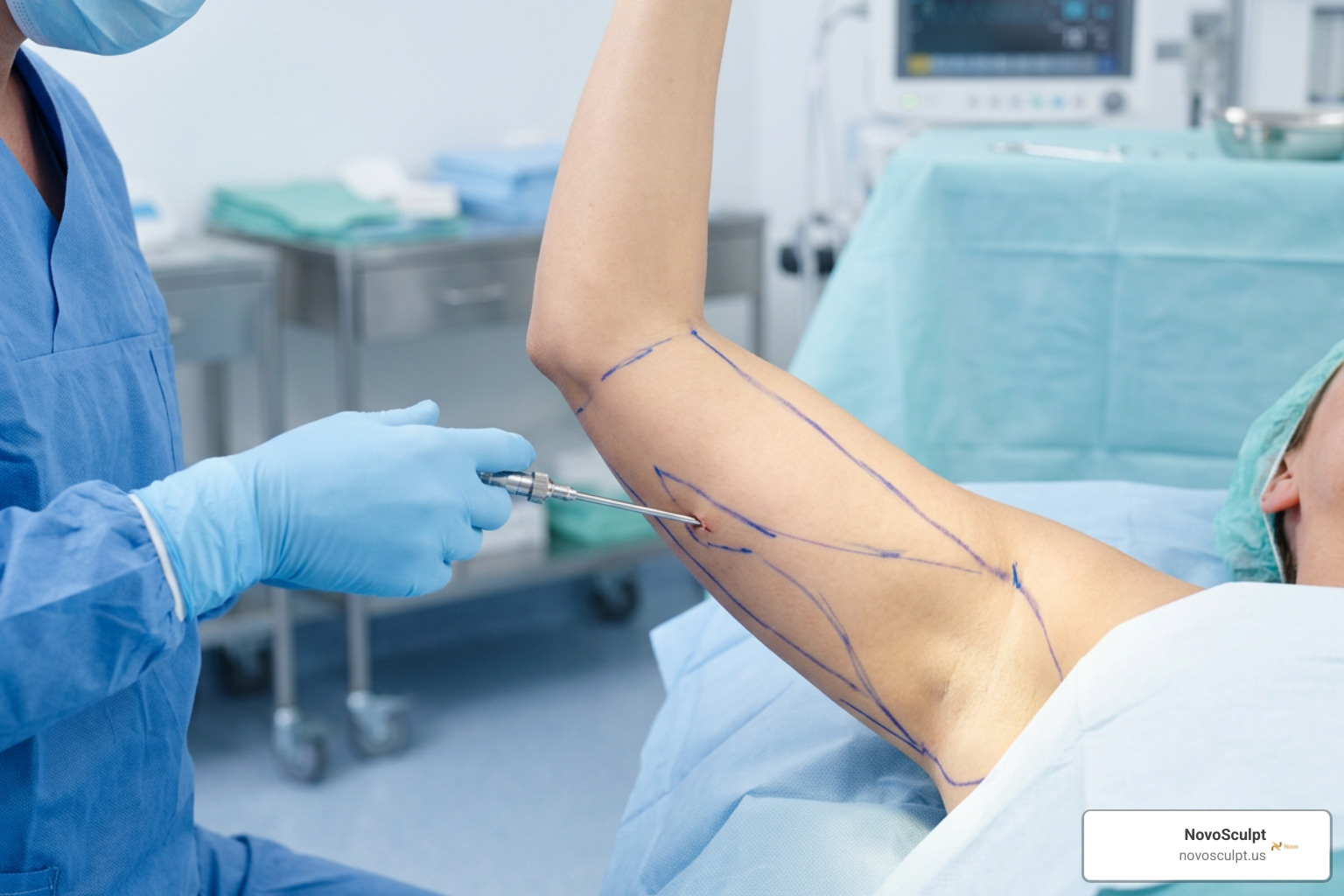
Upper-arm liposuction uses a cannula inserted through small access points to remove selected subcutaneous fat. Tumescent anesthesia involves placing fluid containing local anesthetic and other medications into the treatment area before fat removal. At NovoSculpt, selected upper-arm body-contouring procedures are performed under local/tumescent anesthesia while the patient remains awake.
For selected patients whose primary concern is localized upper-arm subcutaneous fat and who do not require substantial skin excision, NovoSculpt® may offer an awake/local-anesthesia body-contouring option. The goal is targeted fat reduction and improvement in upper-arm contour, not a guaranteed shape or a substitute for every type of arm lift.
If skin laxity is also present, individualized evaluation should determine whether fat removal alone, NovoTight®, NovoTuck®, a conventional brachioplasty, or another approach is appropriate. NovoTight® may provide skin and tissue tightening support for selected patients, while NovoTuck® may address targeted skin reduction in selected cases. These options are not the same as a full brachioplasty and are not needed for every patient.
Skin may adapt to some degree after fat removal, particularly when baseline elasticity is favorable, but the degree of contraction is variable and cannot be guaranteed. Significant loose skin may require a skin-tightening or excisional procedure.
For more background on minimally invasive body-contouring concepts, see NovoSculpt’s guide to minimally invasive liposuction and body sculpting.
Brachioplasty / Arm Lift Surgery
Brachioplasty, commonly called an arm lift, is an established surgical option for selected patients with significant upper-arm skin excess and/or tissue laxity. It may include removal of excess skin, reshaping of soft tissue, and, in some cases, fat reduction.
Brachioplasty is not limited to one type of patient or one incision pattern. Incision length, anesthesia, surgical setting, drain use, recovery, and scarring depend on anatomy, surgical technique, treatment extent, surgeon preference, and individual circumstances. For some patients, brachioplasty may be the more appropriate treatment when significant redundant skin cannot be adequately addressed with fat removal alone.
Like any surgery, brachioplasty has potential risks, including bleeding, infection, seroma, hematoma, wound-healing issues, altered sensation, visible scarring, asymmetry, contour irregularity, fluid-related complications, and the possible need for revision. A qualified surgeon should explain how those risks apply to the individual patient.
Liposuction vs. Brachioplasty: Balanced Comparison
| Feature | Liposuction / Minimally Invasive Arm Contouring | Brachioplasty / Arm Lift |
|---|---|---|
| Primary concern addressed | Localized subcutaneous fat | Significant loose skin, tissue laxity, and sometimes fat |
| Fat removal | Yes, selected fat is physically removed | May be combined with fat removal depending on the surgical plan |
| Loose-skin removal | Does not reliably remove significant redundant skin | Designed to remove excess skin in selected patients |
| Incisions/access points | Usually small cannula access points | Incision pattern and length vary by anatomy and technique |
| Anesthesia | May be performed with local/tumescent anesthesia in selected settings, including at NovoSculpt | May involve local, sedation, or general anesthesia depending on the case and surgeon |
| Scarring | Small access-point marks may occur | Scarring varies with incision design, healing, and treatment extent |
| Recovery | Varies by patient and treatment extent | Varies by procedure extent, incision pattern, and individual healing |
| Best suited for | Patients whose main concern is localized fat with enough skin elasticity for a reasonable contour response | Patients whose main concern is significant redundant skin or laxity |
| Important limitation | Skin tightening is variable and cannot be guaranteed | Involves surgical incisions and a more extensive skin-reduction plan |
Candidate Evaluation: Choosing the Right Arm Fat Removal Approach
Determining the right approach to arm fat removal requires an in-person clinical assessment by a qualified medical professional. Online education can help patients understand the options, but it cannot replace a physical exam.

During an evaluation, the clinician may assess the thickness of the subcutaneous fat layer, skin elasticity, the amount of redundant skin, muscle anatomy, and overall arm proportions. A complete candidacy discussion may also include:
- Medical history and overall health
- Weight stability and recent weight changes
- Fat distribution and body composition
- Skin elasticity and tissue quality
- Nicotine use
- Current medications and supplements
- Bleeding risk and clotting history
- Previous surgery or scarring patterns
- Amount and location of redundant skin
- Expectations and goals
- Treatment extent and recovery needs
- Physician judgment about safety and suitability
Common Treatment Considerations by Main Concern
Patients often fall into broad descriptive groups, although these are not formal clinical categories:
- Localized fat with relatively good skin elasticity: Liposuction or awake minimally invasive arm contouring may be considered when the primary concern is subcutaneous fat and the skin appears likely to adapt reasonably.
- Localized fat plus mild or moderate laxity: Fat removal alone may help contour, but skin response is variable. A clinician may discuss whether skin/tissue tightening support such as NovoTight® is appropriate.
- Significant redundant skin: When loose skin is a major part of the concern, brachioplasty, NovoTuck®, or another skin-reduction approach may be discussed. The best option depends on anatomy, goals, and the amount of skin excess.
No single procedure is universally superior. The safest and most useful recommendation is the one that matches the patient’s anatomy, medical history, skin quality, and expectations.
Recovery After NovoSculpt Upper-Arm Contouring
Recovery guidance should come from the treating clinician because treatment extent and healing vary. After minimally invasive arm contouring at NovoSculpt, walking generally begins early, and patients may experience swelling, bruising, soreness, pressure, and tenderness. Compression is generally used according to individualized postoperative instructions.
Return to work and daily routines varies by patient and treatment extent. Return to full activity may occur at approximately two weeks depending on the patient and procedure. Heavy exercise should generally wait approximately six weeks unless the treating surgeon provides different individualized guidance.
Swelling and contour refinement may continue for several months. Patients should follow their postoperative instructions, attend recommended follow-up visits, and contact their care team promptly for concerns such as worsening pain, increasing swelling, fever, drainage, shortness of breath, or other unexpected symptoms.
To view examples of patient outcomes, explore NovoSculpt’s before and after gallery, or read more about how NovoSculpt differs from traditional liposuction practices.
Risks, Results, Insurance, and FAQs About Upper-Arm Contouring
Risks of Arm Liposuction and Arm Contouring
Awake/local-anesthesia treatment does not eliminate surgical risk. Potential risks of liposuction or minimally invasive arm contouring can include bleeding, bruising, swelling, infection, seroma, hematoma, altered sensation, contour irregularity, asymmetry, scarring or access-point marks, medication or local-anesthetic complications, fluid-related complications, need for revision, and uncommon thromboembolic complications.
General anesthesia may not be part of selected NovoSculpt procedures, but any procedure performed without general anesthesia still retains the surgical, medication-related, and healing risks of that procedure. General anesthesia itself is not inherently inappropriate; anesthesia planning should be individualized.
Results and Longevity
Liposuction physically removes selected fat cells from the treated area. Remaining fat cells can enlarge with future weight gain, and upper-arm contour can change with aging, pregnancy, hormonal changes, weight fluctuations, muscle changes, and changes in skin elasticity.
Results may be long-lasting when body weight remains relatively stable, but no procedure can stop natural aging or guarantee that the arm contour will remain unchanged.
Insurance and Cost Considerations
Cosmetic arm contouring is generally not covered by health insurance. In selected reconstructive or medically necessary circumstances, coverage for excisional surgery may depend on the patient’s policy, documented symptoms, medical necessity criteria, prior treatment, and insurer requirements.
Patients should contact their insurer directly for policy-specific guidance. NovoSculpt can discuss treatment planning and payment options, but insurance coverage decisions are made by the insurer.
Frequently Asked Questions About Arm Fat Removal
What is arm fat removal?
Arm fat removal refers to procedures that reduce selected subcutaneous fat in the upper arms. It may include liposuction or another body-contouring approach, depending on anatomy, skin elasticity, goals, and medical history.
Can exercise get rid of upper-arm fat?
Exercise can strengthen the triceps and improve overall body composition, but it cannot selectively remove fat from one location. Localized upper-arm fat may persist even with consistent diet and exercise.
Can liposuction remove upper-arm fat?
Yes. Upper-arm liposuction can remove selected subcutaneous fat through small cannula access points. It is most relevant when fat volume, rather than significant loose skin, is the main concern.
Does arm liposuction tighten loose skin?
Arm liposuction does not reliably correct significant loose skin. Some skin adaptation may occur when elasticity is favorable, but the degree of contraction varies and cannot be guaranteed.
What is the difference between arm liposuction and brachioplasty?
Arm liposuction removes selected fat. Brachioplasty, or arm lift surgery, removes excess skin and reshapes the upper arm. Some patients need fat removal, some need skin reduction, and some may need a combined plan.
Who may be a candidate for awake arm contouring?
A patient may be considered for awake arm contouring when localized upper-arm fat is the main concern, overall health is appropriate, expectations are realistic, and the clinician believes local/tumescent anesthesia is suitable.
How long does recovery take after arm contouring?
Recovery varies. Swelling, bruising, soreness, pressure, and tenderness may occur. Walking often begins early, compression may be recommended, and return to work or normal routines depends on the patient and procedure extent.
When can I exercise after arm contouring?
Activity should follow the treating surgeon’s instructions. Return to full activity may occur at approximately two weeks depending on the patient and procedure, while heavy exercise should generally wait approximately six weeks unless individualized instructions say otherwise.
Are arm-contouring results permanent?
Results may be long-lasting, especially when weight remains relatively stable. However, arm contour can still change with aging, weight fluctuation, pregnancy, hormonal changes, muscle changes, and skin-elasticity changes.
Can arm fat return after liposuction?
The selected fat removed by liposuction is physically removed from the treated area, but remaining fat cells can enlarge with future weight gain. Overall body composition still matters after treatment.
Does arm liposuction leave scars?
Arm liposuction uses small access points, and marks may occur. Their visibility depends on access placement, healing, skin type, pigmentation tendencies, and postoperative care.
When might an arm lift be more appropriate?
An arm lift may be more appropriate when significant redundant skin or tissue laxity is the main concern. A consultation helps determine whether skin reduction is more relevant than fat removal alone.
Medical References
- Cleveland Clinic. Brachioplasty (Arm Lift): Surgery, Recovery & What to Expect.
- American Society of Plastic Surgeons. Arm Lift Risks and Safety.
- Sisti A, Cuomo R, Milonia L, Tassinari J, Castagna A, Brandi C, Grimaldi L, D’Aniello C, Nisi G. Complications associated with brachioplasty: a literature review. Acta Biomed. 2018;88(4):393-402. doi:10.23750/abm.v88i4.5609. PMID: 29350652.
- Aljerian A, Abi-Rafeh J, Ramirez-GarciaLuna J, Hemmerling T, Gilardino MS. Complications in Brachioplasty: A Systematic Review and Meta-Analysis. Plastic and Reconstructive Surgery. 2022;149(1):83-95. doi:10.1097/PRS.0000000000008652. PMID: 34936607.
- Miotto G, Ortiz-Pomales Y. Arm Contouring: Review and Current Concepts. Aesthetic Surgery Journal. 2018;38(8):850-860. doi:10.1093/asj/sjx218. PMID: 29546270.
- Halk AB, Habbema L, Genders RE, Hanke CW. Safety Studies in the Field of Liposuction: A Systematic Review. Dermatologic Surgery. 2019;45(2):171-182. doi:10.1097/DSS.0000000000001707. PMID: 30702445.
- Aljerian A, Abi-Rafeh J, Hemmerling T, Gilardino MS. Complications of Aesthetic Liposuction Performed in Isolation: A Systematic Literature Review and Meta-Analysis. Plastic Surgery (Oakville). 2024;32(1):19-32. doi:10.1177/22925503221078693. PMID: 38433796.
Conclusion
Upper-arm contour depends on the relative contribution of subcutaneous fat, skin laxity, muscle anatomy, and overall body composition. Liposuction may be appropriate when localized fat is the main concern, while significant redundant skin may require excisional surgery. Arm fat removal should be planned around anatomy, medical history, skin elasticity, goals, and procedure extent rather than a one-size-fits-all procedure choice.
NovoSculpt serves patients from its Cos Cob/Greenwich, Connecticut location, including people from Greenwich, Fairfield County, and nearby Westchester County, New York. For appropriately selected patients, NovoSculpt offers awake/local-anesthesia body-contouring options performed without general anesthesia while retaining the surgical and medication-related risks of the procedure.
To discuss whether NovoSculpt®, NovoTight®, NovoTuck®, or another approach may fit your goals—and whether a more extensive surgical procedure may be more appropriate—schedule a consultation with NovoSculpt.
