
Breast Augmentation: Your Options at a Glance
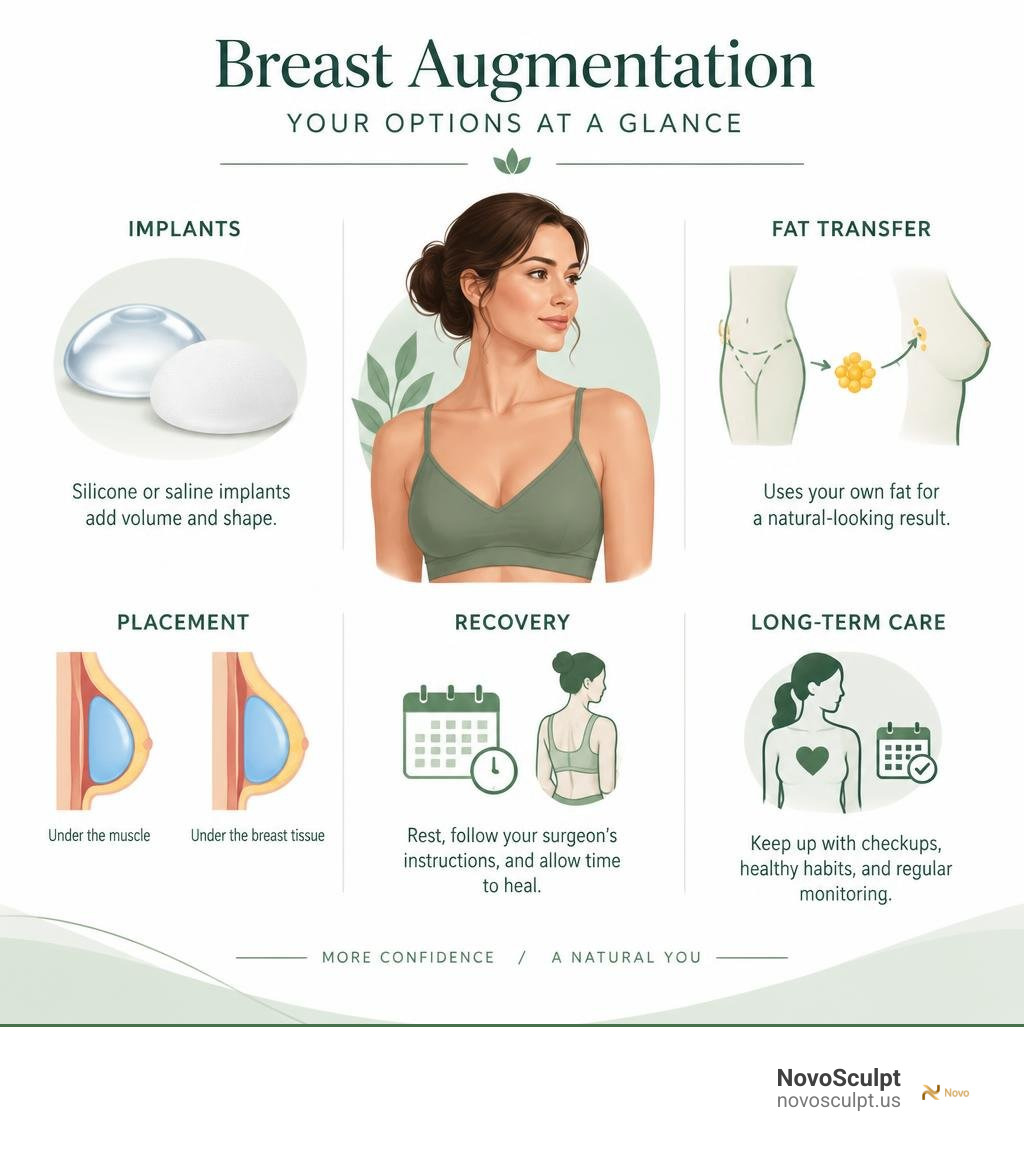
Breast augmentation is surgery that adds breast volume or improves shape and symmetry. It can use saline or silicone implants, or your own fat through fat transfer. The right approach depends on how much volume you want, your existing breast tissue, your health, and whether you also need a breast lift for sagging.
People often consider augmentation to restore fullness after pregnancy, breastfeeding, weight loss, or aging. Others want to address natural asymmetry or reconstruct a breast after mastectomy. It can improve projection and balance, but implants do not last forever, and augmentation alone does not correct significant drooping.
This guide explains the choices that matter before you decide: implant versus fat transfer, incision and placement options, recovery, costs, and long-term safety. The best first step is a detailed consultation with a qualified plastic surgeon who can match the plan to your anatomy and goals.
Written by Roberto Magana, BSc, MBA — CEO, NovoSculpt. NovoSculpt’s practice location is in Cos Cob, Greenwich, Connecticut, and serves patients from Greenwich, Fairfield County, and nearby Westchester County, New York. Individual treatment recommendations require an in-person medical and anatomical assessment.
Understanding Breast Augmentation: Types, Purposes, and Candidacy
Breast enhancement remains one of the most widely performed aesthetic surgeries in modern plastic surgery. While casual conversation often lumps every procedure under the phrase “boob job,” the modern approach to breast surgery is sophisticated, tailored, and nuanced. Patients seek out breast surgery for a diverse set of aesthetic and functional indications. Some individuals wish to address congenital asymmetry—where one breast differs visibly in volume, shape, or position from the other. Others desire volume restoration following pregnancy, lactation, significant weight loss, or the natural involution of glandular tissue that accompanies aging.
Additionally, breast augmentation serves vital reconstructive purposes, whether correcting developmental conditions such as tuberous breast deformity or reconstructing the breast mound following mastectomy or lumpectomy. A thorough clinical overview of indications and anatomy highlights how underlying chest wall anatomy, soft-tissue envelope thickness, and glandular density dictate the surgical approach required for each individual.
It is equally important to recognize the procedure’s limits. Augmentation may improve volume and projection, but it does not reliably correct moderate or severe breast ptosis (drooping). Whether a mastopexy (breast lift) is appropriate depends on nipple position, skin quality, breast volume, desired size, and the patient’s goals; some patients may benefit from a combined or staged approach.
Comparing Implant Types and Fat Transfer Breast Augmentation
When planning breast enhancement, patients may choose between implants and autologous fat grafting. At NovoSculpt, appropriately selected patients may discuss Motiva breast implants under local anesthesia and NovoGain™ autologous breast fat transfer. These options are not suitable for every patient: candidacy depends on medical history, breast anatomy, tissue characteristics, desired change, and the surgical team’s assessment. Local anesthesia may avoid general anesthesia for selected procedures, but it does not eliminate surgical or anesthesia-related risks and does not ensure a faster recovery.
- Saline Implants: These implants have a silicone outer shell and are filled with sterile saline. A rupture is usually noticeable because the breast loses volume as the saline is absorbed; visible rippling can be more noticeable when soft-tissue coverage is limited.
- Silicone Gel Implants: These implants are prefilled with silicone gel. A rupture may not be apparent on examination alone, so follow-up and imaging recommendations should be individualized according to current FDA labeling and clinician guidance.
- Structured Saline Implants: These implants use internal chambers or structure with saline fill. Their potential advantages and limitations should be discussed in relation to a patient’s anatomy and goals.
- Autologous Fat Transfer: NovoGain™ uses a patient’s own fat, collected through liposuction, processed, and grafted to the breasts. It may be an option for selected patients seeking a modest volume change without an implant, but retained volume can vary and additional treatment may be considered.
Who Is an Ideal Candidate for Breast Augmentation?
Determining candidacy involves evaluating physical health, anatomical landmarks, and emotional readiness. During the initial assessment, the treating surgical team evaluates baseline breast tissue volume, skin elasticity, chest-wall symmetry, medical history, and the patient’s goals.
Key criteria for an ideal candidate include:
- Physical Maturity and Health: Breast development, general health, active infections, chronic conditions, medications, and healing risks should be assessed individually.
- Nicotine Exposure: Nicotine can impair wound healing and increase complications. The recommended cessation plan and timing should be set by the treating clinician.
- Screening and Imaging: Age- and risk-appropriate breast screening should continue. Any imaging plan before or after surgery should be individualized.
- Realistic Expectations: Augmentation can alter size and shape, but implants require monitoring and are not lifetime devices.
Surgeons cross-reference these individual factors against established patient candidacy guidelines to ensure safety and predictability.
Surgical Techniques, Placement, and Incision Options
Every breast procedure must be engineered around the patient’s individual tissue dimensions. The surgeon selects the incision site and the anatomical plane for the pocket to optimize soft-tissue coverage and conceal scars.
Incision Types and Pocket Placement Options
The incision and implant-pocket plan are selected according to anatomy, implant choice, prior surgery, tissue characteristics, and patient priorities. The following approaches are commonly discussed; not every option is appropriate for every patient. Detailed surgical approach and technique details provide additional background:
- Inframammary Incision: Placed in the breast crease. It can provide direct access to the implant pocket, but scar appearance and suitability vary with breast shape, implant selection, and healing.
- Periareolar Incision: Placed along the border of the areola. It may be considered in selected cases, but potential effects on nipple sensation and breastfeeding should be discussed individually.
- Transaxillary Incision: Placed in the armpit. It may avoid a scar on the breast itself, although its suitability, visualization, and options for future revision depend on the operative plan.
Once the access point is established, the surgeon positions the implant within one of two main anatomical pockets:
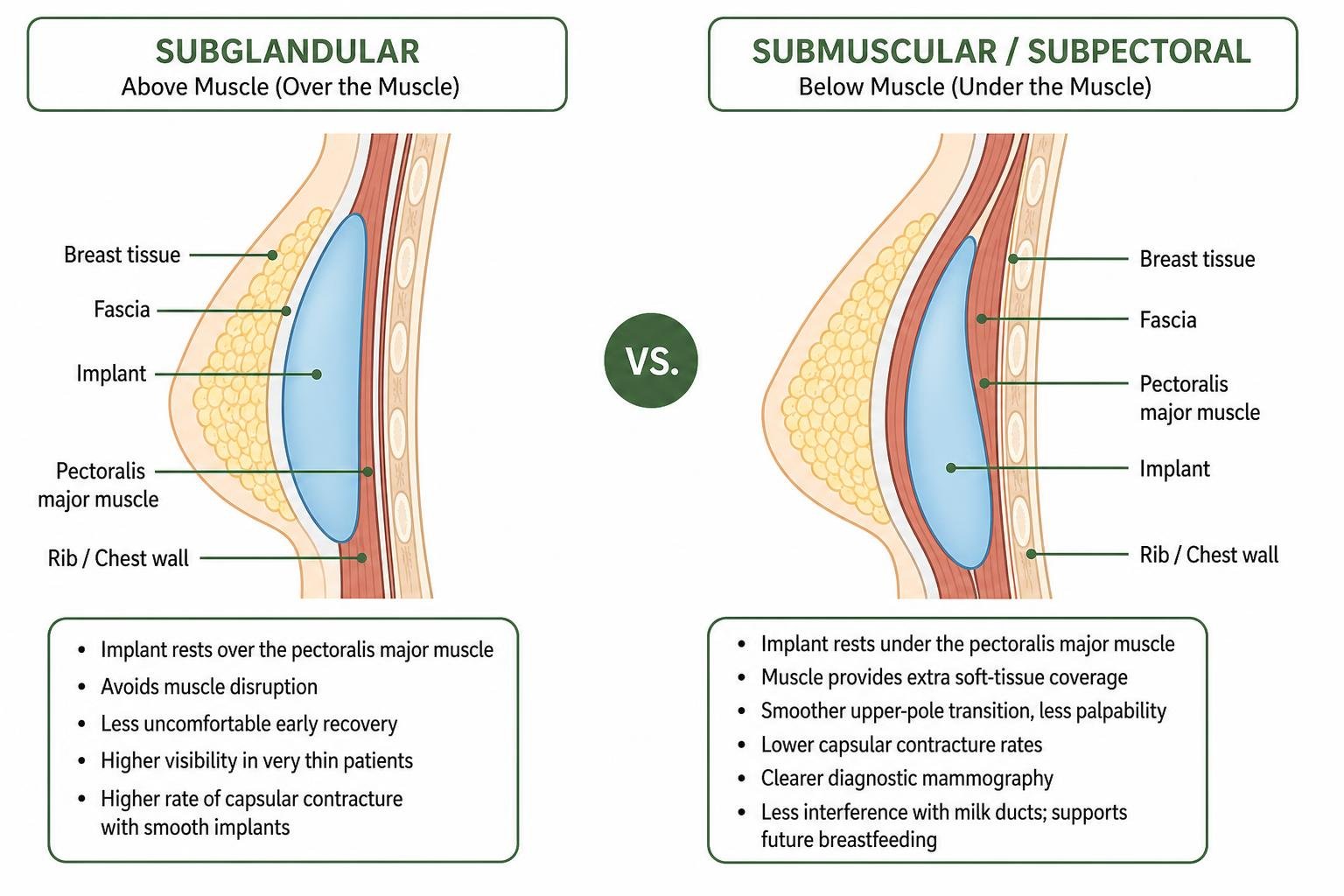
- Subglandular (Over the Muscle): The implant is placed behind breast tissue and in front of the chest muscle. It may be considered when tissue coverage and goals support it, but implant visibility, rippling, recovery, and other trade-offs vary by patient.
- Submuscular or Dual-Plane (Partially Under the Muscle): The upper portion of the implant may be placed beneath the pectoralis muscle. This can provide additional upper-pole coverage for some patients, but it can also affect movement, discomfort, and recovery. Implant placement alone does not determine future breastfeeding ability; breast anatomy, incision, glandular tissue, and surgical technique can all matter.
Recovery, Safety Considerations, and Long-Term Results
Understanding postoperative care and potential long-term maintenance is essential for recovery and informed decision-making. Recovery experiences, aesthetic satisfaction, and the need for future procedures vary by procedure type, anatomy, healing, implant characteristics, and individual circumstances.

Healing Timeline and Long-Term Care Protocols
After surgery, patients may be advised to wear a supportive bra or compression garment, depending on the procedure and clinician guidance. Soreness, swelling, tightness, and return to daily activities vary; the treating team should provide individualized instructions and warning signs that require prompt follow-up.
- Early recovery: Rest, limited lifting, wound care, and gentle activity are commonly recommended, but the details depend on the procedure and clinician instructions.
- Return to routine activities: Some patients resume light activities sooner than others. Work demands, pain control, swelling, and the operative approach influence timing.
- Exercise and lifting: More strenuous activity, upper-body exercise, and contact sports should resume only when cleared by the treating clinician.
- Longer-term healing: Swelling, implant settling, scar maturation, and the final contour can continue to change over months.
Consulting a comprehensive safety and risk analysis prepares patients for possible long-term considerations:
- Capsular Contracture: Scar tissue normally forms around an implant. If the capsule tightens or thickens, the breast may feel firm, look distorted, or cause discomfort; treatment depends on severity and clinical findings.
- Implant Rupture and Monitoring: Implants are not lifetime devices, but they do not require routine replacement at one fixed interval. Saline rupture is often noticeable; silicone rupture can be silent. Follow current FDA labeling and the treating clinician’s recommendations for symptoms, examinations, and imaging.
- Breast Implant–Associated Cancers: Breast implant-associated anaplastic large cell lymphoma is an established but uncommon risk associated more often with textured implant surfaces. The FDA has also reported rare cases of squamous cell carcinoma and other lymphomas in the capsule around breast implants. New or persistent swelling, a mass, pain, or changes around an implant require prompt medical evaluation.
- Systemic Symptoms: Some people report systemic symptoms sometimes called breast implant illness. The FDA recognizes these reports, while the cause and relationship to implants remain under study. A clinician can help evaluate symptoms and discuss appropriate next steps.
For balanced, current risk information, review the FDA’s breast implant risks and complications guidance and information for people considering breast implants.
Frequently Asked Questions about Breast Enhancement
What is the typical recovery timeline after surgery?
Recovery is individualized. Some patients can return to light daily activities relatively soon, while others need more time depending on the procedure, implant placement, pain control, work demands, and healing. Bruising and swelling commonly improve gradually, and lifting, strenuous exercise, and other restrictions should follow the treating clinician’s instructions.
How long do implants typically last before replacement?
Breast implants are not lifetime devices, but there is no universal schedule for replacing them. Removal or revision may be considered because of rupture, capsular contracture, discomfort, cosmetic changes, personal preference, or other clinical reasons. Follow-up should be based on symptoms, examinations, current FDA labeling, and individualized clinician guidance.
Does health insurance cover the procedure?
Elective cosmetic breast enlargement is typically paid for out of pocket. Coverage for reconstructive breast surgery can depend on the medical indication, the insurance plan, prior-authorization requirements, and applicable federal or state legal requirements. Patients should confirm benefits and coverage criteria directly with their insurer and care team.
Conclusion: Achieving Your Desired Aesthetic
Choosing to enhance your breasts is a deeply personal decision that balances aesthetic harmony, anatomical safety, and self-confidence. Whether you opt for cohesive silicone devices, saline implants, or a natural fat transfer breast augmentation, the key to achieving beautiful, durable results lies in transparent planning and individualized surgical execution.
At NovoSculpt, selected patients may discuss physician-led breast enhancement options, including NovoGain™ fat transfer and Motiva implants under local anesthesia when medically and anatomically appropriate. Local anesthesia may be an option for some procedures, but it does not eliminate risks or make every patient a candidate. NovoSculpt’s single practice location is in Cos Cob, Greenwich, Connecticut, serving patients from Greenwich, Fairfield County, and nearby Westchester County, New York. Schedule a personalized consultation to review candidacy, alternatives, expected recovery, and the treatment approach that best fits your goals.
