
Understanding What Is Awake Liposuction: Mechanism and Tumescent Anesthesia
Written by Roberto Magana, BSc, MBA, CEO, NovoSculpt
Last Updated: September 8, 2026
This article is intended for general education and does not replace an individualized evaluation by a qualified medical professional.
Quick Answer
What is awake liposuction? Awake liposuction is liposuction performed with local or tumescent anesthesia while the patient remains conscious rather than undergoing general anesthesia. It is an anesthesia approach to liposuction, not a separate biological method of fat removal. The appropriate anesthesia plan depends on treatment extent, patient factors, procedure setting, and physician judgment.
Key Takeaways
- Local/Tumescent Anesthesia: Awake liposuction uses dilute local anesthetic placed into the treatment area, commonly with a carrier solution, lidocaine, epinephrine, and sometimes a buffering agent.
- Conscious Procedure: Patients remain awake and can usually communicate with the surgical team during treatment, though individual protocols vary.
- Direct Fat Removal: Liposuction physically removes targeted subcutaneous fat using a cannula; it does not remove visceral fat inside the abdominal cavity.
- Not Weight Loss: Awake liposuction is a body-contouring procedure for localized fat, not a treatment for obesity or major weight reduction.
- Risks Remain: Avoiding general anesthesia avoids risks specifically associated with general anesthesia, but it does not eliminate surgical, medication-related, cardiovascular, thromboembolic, or recovery risks.
- Individualized Candidacy: Candidates are generally at a reasonably stable weight with localized subcutaneous fat, realistic expectations, and health factors that support elective surgery.
- Variable Recovery: Recovery, discomfort, swelling, and return to activity vary according to the patient, treatment area, treatment extent, and physician guidance.
Awake liposuction represents one approach to surgical body contouring: the fat-removal portion of liposuction is performed while the patient remains conscious under local/tumescent anesthesia. Liposuction itself can be performed using different anesthesia approaches, including local anesthesia, sedation, or general anesthesia, depending on the treatment plan, patient health, surgical setting, and physician judgment.
Tumescent anesthesia involves placing a dilute anesthetic solution into the subcutaneous fat layer before fat removal. Formulations vary, but they commonly include:
- A carrier solution such as sterile saline: Provides volume that helps expand and firm the fatty layer so the cannula can move through the treatment area more predictably.
- A local anesthetic such as lidocaine: Helps reduce pain signals from the treated area. It is intended to improve comfort, but it does not guarantee that every sensation is absent.
- Epinephrine: Narrows small blood vessels temporarily, which can help reduce bleeding during the procedure and slow systemic absorption of the anesthetic.
- A buffering agent such as sodium bicarbonate, when used: May reduce the stinging sensation associated with local anesthetic infiltration for some patients.
Once infused, the subcutaneous compartment becomes swollen, firmer, and anesthetized to a clinically useful degree. Epinephrine-induced vasoconstriction can help reduce bleeding during the procedure, and local anesthetic effects may continue into the early recovery period. Total anesthetic dosing must be carefully calculated and monitored according to patient and procedural factors; local anesthetic toxicity remains a potential complication. Peer-reviewed literature on tumescent anesthesia and liposuction dosing is available through PubMed for readers who want additional medical background: Ostad, Kageyama, and Moy, 1996.
| Feature | Liposuction Under Local/Tumescent Anesthesia | Liposuction Under General Anesthesia |
|---|---|---|
| Consciousness Level | Awake and able to communicate, depending on the protocol | Unconscious under general anesthesia |
| Anesthesia | Local/tumescent anesthetic placed into the treatment area | Systemic general anesthesia managed by an anesthesia professional |
| Airway Management | Usually natural breathing; airway plan depends on clinical circumstances | Airway management varies according to the anesthesia plan and clinical circumstances |
| Patient Communication | Patient may report sensations, discomfort, or positioning concerns | Patient cannot communicate during the anesthetized portion of surgery |
| Procedure Extent | Often used for selected localized treatment areas | May be appropriate for more extensive procedures or combined operations |
| Surgical Setting | Often outpatient; setting should match procedure extent and patient risk | Hospital or ambulatory surgery setting, depending on the case |
| Anesthesia-Related Effects | Avoids risks specifically attributable to general anesthesia, but medication and surgical risks remain | Carries risks and recovery considerations specific to general anesthesia |
| Recovery Considerations | Recovery varies; some patients resume light activities relatively quickly | Recovery varies with procedure extent, anesthesia effects, and individual factors |
| When It May Be Appropriate | Localized subcutaneous fat, appropriate health profile, realistic goals, and a treatment plan suitable for local anesthesia | Larger or more complex procedures, combined surgeries, certain patient circumstances, or surgeon preference |
Defining What Is Awake Liposuction vs Liposuction Under General Anesthesia
The essential distinction between awake liposuction and liposuction performed under general anesthesia is the anesthesia plan, not the basic mechanism of fat removal. In both cases, a cannula is used to remove selected subcutaneous fat from targeted areas.
A conscious patient undergoing awake liposuction may be able to communicate with the surgical team and, when clinically appropriate, change position or engage muscle groups during contour assessment. This feedback may provide additional intraoperative information, but it does not eliminate surgical risks or make one anesthesia approach universally better than another.
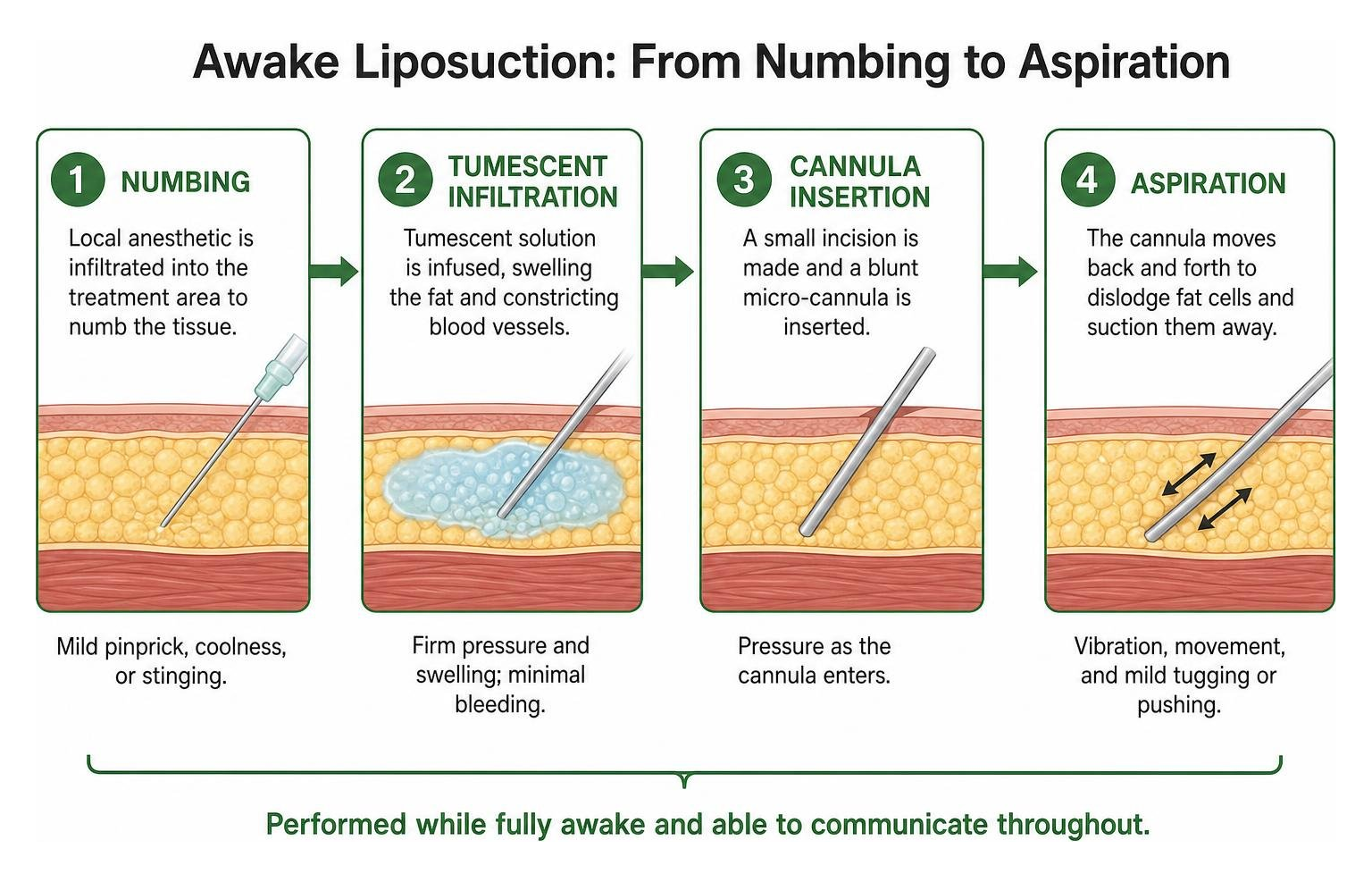
Tumescent anesthesia uses dilute local anesthetic, and total dosing must be carefully calculated according to patient and procedural factors. Following adequate infiltration, the physician creates small access points and introduces specialized blunt-tipped cannulas. Moving the cannula through the expanded fat compartment loosens and removes selected adipose tissue while still causing expected tissue disruption associated with liposuction.
The Patient Experience During the Procedure
- The Infiltration Phase: Patients may feel needle sticks, pressure, coolness, fullness, stinging, or stretching as the anesthetic fluid is introduced.
- The Aspiration Phase: Adequate local anesthesia is intended to minimize sharp procedural pain, although individual sensations and comfort levels vary. Patients may feel pressure, vibration, movement, pushing, or tugging.
- Continuous Communication: Patients can usually speak with the clinical team about comfort, positioning, and unexpected sensations during treatment.
- Dynamic Assessment: When clinically appropriate, the physician may ask a patient to adjust position or engage certain muscle groups to help assess contour.
What Are the Risks of Awake Liposuction?
Liposuction is a surgical procedure with recognized risks. The type and magnitude of those risks depend on factors including the patient’s health, procedure extent, anesthesia approach, surgical setting, and postoperative care.
At NovoSculpt, the practice performs Minimally Invasive Liposuction using local-anesthesia protocols and treatment planning by fully accredited plastic surgeons. That does not mean awake liposuction is risk-free, universally safer, or appropriate for every patient.
Anesthesia Risks and Clinical Safety Considerations
Avoiding general anesthesia avoids complications that are specifically attributable to general anesthesia. However, awake liposuction remains a surgical procedure, and risks such as bleeding, infection, fluid collections, contour irregularities, medication-related complications and, rarely, thromboembolic events can still occur.
Because the patient remains conscious, the patient may be able to communicate unexpected sensations to the surgical team during treatment. This feedback may provide additional intraoperative information, but it does not eliminate surgical risks.
Key safety considerations include:
- Local Anesthetic Dosing: Lidocaine and other medication dosing must be calculated and monitored carefully according to patient factors, treatment area, and procedure extent. Local anesthetic toxicity is uncommon but can be serious.
- Bleeding Control: Epinephrine-induced vasoconstriction can reduce bleeding, but bruising, hematoma, and bleeding-related concerns can still occur.
- Fluid Management: Tumescent fluid is part of the procedure, and fluid-related complications are possible if the procedure is not properly planned and monitored.
- Procedure Extent: Larger or more complex treatment plans may require different anesthesia choices, staging, or a surgical setting with additional monitoring resources.
Known Side Effects and Complication Management
Although awake liposuction avoids general anesthesia, it remains a genuine surgical procedure accompanied by anticipated healing responses and possible complications:
- Postoperative Edema: Swelling is a normal reaction to tissue trauma and fluid infiltration. It often peaks in the early postoperative period and gradually improves over weeks to months.
- Bruising and Soreness: Localized bruising and soreness can occur and vary by patient and treatment extent.
- Temporary Paresthesia: Numbness, tingling, or altered sensation may occur due to temporary sensory nerve irritation. Sensation often improves over time, but recovery varies.
- Seroma and Hematoma: Fluid collections or blood collections can occur and may require clinical evaluation or treatment.
- Contour Irregularities and Asymmetry: Rippling, unevenness, depressions, or asymmetry can occur due to anatomy, skin elasticity, scarring, healing, or fat-removal patterns.
- Access-Point Scarring: Small incision sites can leave scars, although they are usually limited in size.
- Infection: Infection is uncommon under sterile protocols but remains a possible surgical risk.
- Need for Revision: Some patients may need revision or additional treatment depending on healing, goals, anatomy, and outcome.
- Thromboembolic Events: Blood clots such as deep vein thrombosis (DVT) or pulmonary embolism are uncommon but potentially serious surgical complications; avoiding general anesthesia does not make them impossible.
Candidacy, Treatable Areas, and Limitations
Awake liposuction is designed for targeted fat reduction rather than whole-body transformation. Understanding your anatomy and setting realistic expectations are essential first steps.
Candidates are generally at a reasonably stable weight and have localized subcutaneous fat that is disproportionate to their overall body composition. Candidacy depends on individualized evaluation of:
- Overall Health and Medical History: Cardiovascular, metabolic, kidney, liver, bleeding, and medication-related factors can affect whether elective liposuction is appropriate.
- Fat Distribution: Liposuction treats subcutaneous fat, not deep visceral abdominal fat.
- Skin Elasticity: Skin with better elasticity is more likely to adapt smoothly after fat removal; significant laxity may require a different or additional approach.
- Weight Stability: Large ongoing weight changes can affect both candidacy and long-term contour.
- Nicotine Use: Smoking and nicotine exposure can impair healing and may increase complication risk.
- Medications and Bleeding Risk: Blood thinners, supplements, and conditions that affect clotting must be reviewed before surgery.
- Treatment Extent: The number and size of areas treated influence anesthesia planning, recovery, and procedural setting.
- Realistic Expectations: Liposuction can improve contour, but it cannot guarantee symmetry, skin tightening, or a specific silhouette.
Our team evaluates these factors thoroughly during consultations for Awake Body Contouring to determine whether the procedure aligns with a patient’s anatomical profile and goals.
Clarifying What Is Awake Liposuction for Body Contouring vs Weight Loss
A frequent point of confusion is whether liposuction acts as a weight-loss method. It does not.
- Subcutaneous Fat vs. Visceral Fat: Awake liposuction can only remove subcutaneous fat—the pinchable layer resting directly beneath the skin and above the muscle wall. It cannot remove visceral fat, which sits deep inside the abdominal cavity surrounding internal organs. Visceral fat cannot be removed with liposuction and is generally addressed through weight management and, when appropriate, medical evaluation and treatment.
- Adipocyte Removal vs. Cell Shrinkage: When body weight changes through diet, exercise, medication, or other interventions, fat cells can shrink or enlarge. Liposuction physically removes selected fat cells from the treated area. However, remaining fat cells in treated and untreated areas can enlarge with future weight gain.
What Type of Fat Does Awake Liposuction Remove?
Awake liposuction removes subcutaneous fat, the fat located beneath the skin. This is the type of fat that can be accessed and physically removed with a cannula during liposuction.
Visceral fat is different. It is located deeper inside the abdominal cavity around internal organs and cannot be removed with liposuction. A protruding abdomen may therefore not always be corrected simply by removing additional subcutaneous fat. Abdominal-wall laxity, visceral fat, muscle separation, posture, bloating, or hernias may contribute to abdominal fullness.
What Awake Liposuction Cannot Correct
Awake liposuction does not necessarily correct:
- Significant loose or excess skin
- Diastasis recti
- Abdominal-wall laxity
- Hernias
- Visceral fat
- Obesity
- Major weight-loss needs
Depending on anatomy, a patient may be better served by skin tightening, targeted skin reduction, abdominoplasty, weight management, medical evaluation, or no elective procedure. NovoSculpt treatment planning may incorporate NovoSculpt® for localized fat removal/body contouring, NovoTight® for skin and tissue tightening support, NovoTuck® for targeted skin reduction in selected patients, and NovoGain® for autologous fat transfer when clinically appropriate. These adjuncts are not necessary or appropriate for every patient.
Treatable Body Zones and Fat Volume Considerations
Awake liposuction can address isolated fat deposits across numerous body areas, including:
- Abdomen: Reducing localized upper or lower abdominal subcutaneous fat.
- Flanks & Love Handles: Improving waist contour.
- Back & Bra Line: Reducing localized back fullness.
- Thighs: Addressing disproportionate inner or outer thigh fat.
- Upper Arms: Reducing localized posterior arm fat; skin laxity may require additional evaluation.
- Submental (Chin & Neck): Reducing localized submental fat to improve chin, jawline, and neck contour.
- Male Chest: In selected male patients, liposuction may reduce a fatty component of chest fullness; glandular gynecomastia may require additional surgical treatment.
The amount of fat that can appropriately be removed in one session depends on patient health, treatment extent, anesthesia considerations, surgical setting, applicable standards, and the treating physician’s judgment.
Recovery Timeline and Post-Procedure Expectations
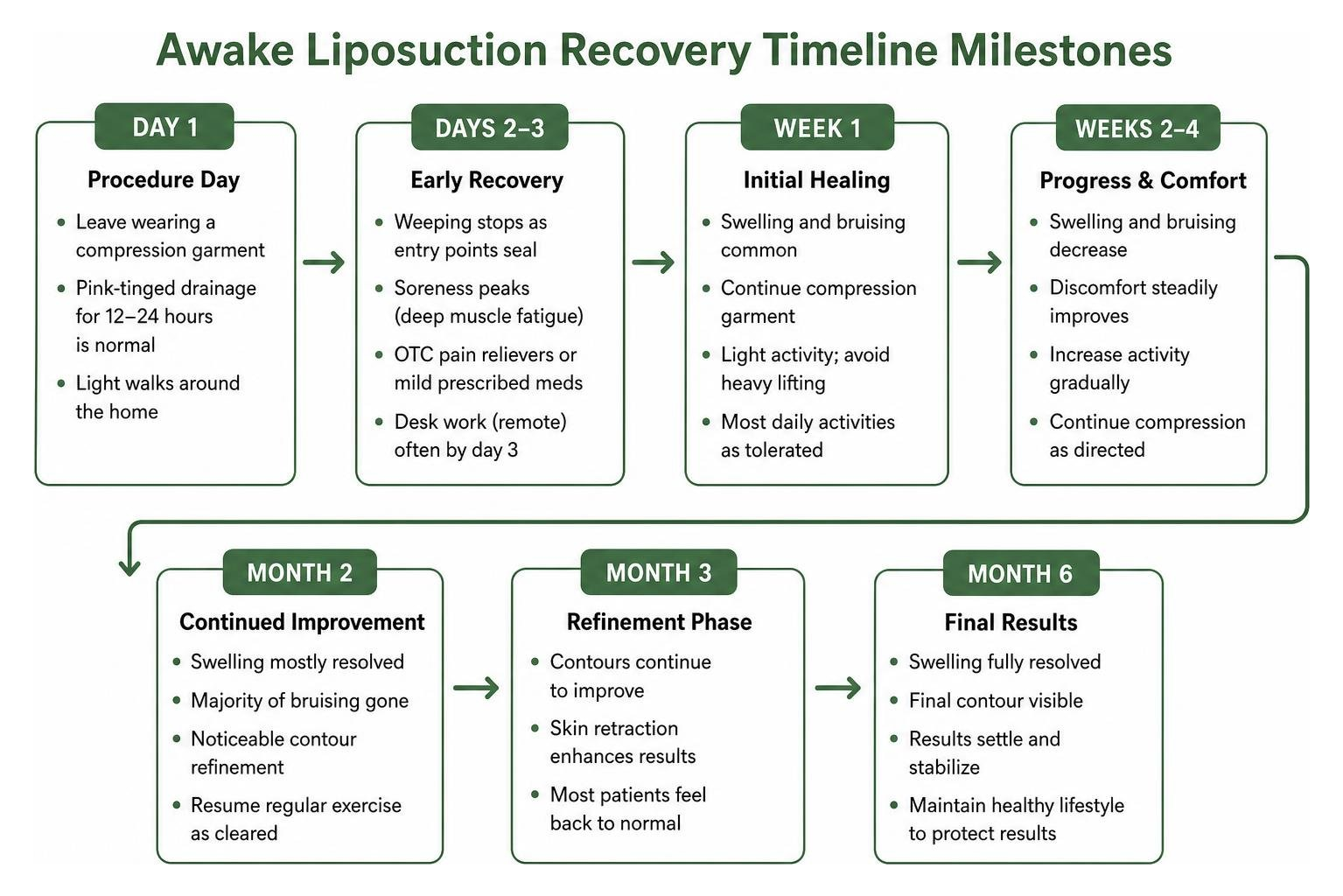
Because awake liposuction avoids general anesthesia, some patients may return to light or desk-based activities relatively quickly, but recovery varies. Treatment extent, the body area treated, swelling, bruising, soreness, work demands, and individual healing all affect recovery.
Immediate Post-Op to Day 3 Recovery
- Procedure Day: Walking generally begins early to support circulation, unless the treating surgeon gives different instructions. Patients leave wearing compression garments.
- First 48 Hours: Drainage from small access points can occur during approximately the first 48 hours. NovoSculpt postoperative guidance instructs patients to keep compression garments in place for the initial 48 hours before showering unless otherwise directed.
- Days 2 to 3: Swelling, bruising, soreness, pressure, and tenderness can occur. Some patients return to light or desk-based activities relatively quickly, but this is not guaranteed and depends on the individual treatment plan.
Long-Term Healing and Result Longevity
- Weeks 1 to 2: Compression generally continues for at least two weeks unless the treating surgeon provides different individualized guidance. Light walking usually continues, while activity increases should follow postoperative instructions.
- Around 2 Weeks: NovoSculpt postoperative instructions indicate that return to full activity may occur at approximately two weeks depending on the patient and treatment.
- Around 6 Weeks: Strenuous activity should generally wait approximately six weeks unless the treating surgeon provides different individualized guidance.
- Months 1 to 6: Swelling gradually improves, firmness can soften, and contour refinement may continue for several months.
Fat cells physically removed from the treated area are removed; however, remaining fat cells can enlarge, and body contour can change with weight fluctuations, pregnancy, aging, hormonal changes, and changes in skin elasticity. Results may be long-lasting when weight remains relatively stable.
What Are the Alternatives to Awake Liposuction?
When evaluating body contouring options, it is helpful to compare awake liposuction with other non-surgical and surgical modalities. Neither anesthesia approach nor body-contouring method is universally best.
- Liposuction Under General Anesthesia: General anesthesia may be appropriate or preferable for more extensive procedures, combined operations, certain patient circumstances, or situations in which the treating surgeon determines it offers an appropriate operative approach. It also carries risks and recovery considerations specific to general anesthesia.
- Non-Invasive Fat Reduction: Non-surgical treatments use external cold, heat, ultrasound, or other energy-based methods to reduce selected fat cells without incisions. These may be preferable for patients seeking non-surgical treatment or those who are not candidates for liposuction, but results, treatment timelines, and suitability vary.
- Skin-Tightening Procedures: Patients with mild to moderate laxity may need skin-tightening support rather than fat removal alone. NovoTight® may be considered in selected NovoSculpt treatment plans.
- Excisional Body Surgery (e.g., Abdominoplasty / Tummy Tuck): For significant loose skin, abdominal-wall laxity, diastasis recti, or hanging folds, liposuction alone may not address the underlying issue. A tummy tuck or other surgical skin-reduction procedure may be more appropriate for selected patients.
- Weight Management: When overall weight reduction or visceral fat reduction is the primary goal, nutrition, activity, medication-based care, and medical evaluation may be more appropriate than liposuction.
- No Elective Procedure: If the risks outweigh the likely benefits, postponing or avoiding elective body contouring may be the most appropriate recommendation.
Frequently Asked Questions About Awake Liposuction
What is awake liposuction?
Awake liposuction is liposuction performed under local/tumescent anesthesia while the patient remains conscious rather than undergoing general anesthesia. It is an anesthesia approach to fat removal, not a separate biological mechanism.
Are you really awake during liposuction?
Yes, patients are awake during awake liposuction and can usually communicate with the surgical team. The exact experience varies based on the protocol, treatment area, and individual comfort.
What anesthesia is used for awake liposuction?
Awake liposuction typically uses tumescent local anesthesia, which commonly includes a carrier solution, lidocaine, epinephrine, and sometimes a buffering agent. The formula and dosage must be individualized and carefully monitored.
Does awake liposuction hurt?
Adequate local anesthesia is intended to minimize sharp procedural pain, but patients may still feel pressure, vibration, tugging, movement, or discomfort. Pain tolerance and comfort vary, and additional measures may be used when clinically appropriate.
Is awake liposuction safe?
Awake liposuction can be appropriate for selected patients when performed by qualified clinicians in an appropriate setting, but it is still surgery. Avoiding general anesthesia avoids risks specifically attributable to general anesthesia, while surgical and medication-related risks remain.
How long does awake liposuction recovery take?
Recovery varies. Walking generally begins early, drainage can occur during approximately the first 48 hours, compression is commonly used for at least two weeks, return to full activity may occur around two weeks, and strenuous activity generally waits approximately six weeks unless the surgeon advises otherwise.
Does liposuction permanently remove fat?
Liposuction removes selected fat cells from the treated area. Remaining fat cells can enlarge with weight gain, and body contour can change with aging, pregnancy, hormonal changes, weight fluctuations, and skin-elasticity changes.
Can awake liposuction remove visceral belly fat?
No. Liposuction removes subcutaneous fat beneath the skin, not visceral fat inside the abdominal cavity around internal organs. Visceral fat is generally addressed through weight management and, when appropriate, medical evaluation and treatment.
Can awake liposuction tighten loose skin?
Liposuction does not reliably correct significant loose skin. Patients with laxity may need skin tightening, targeted skin reduction, abdominoplasty, or another treatment depending on anatomy and goals.
Who is not a good candidate for awake liposuction?
Patients may not be good candidates if they have uncontrolled medical conditions, unrealistic expectations, primarily visceral fat, significant loose skin requiring excision, high bleeding risk, current nicotine use that may impair healing or increase surgical risk, or treatment goals that exceed what can be safely done under local anesthesia.
How does awake liposuction differ from liposuction under general anesthesia?
The main difference is anesthesia. Awake liposuction uses local/tumescent anesthesia while the patient remains conscious; liposuction under general anesthesia is performed while the patient is unconscious under systemic anesthesia.
When might another surgical approach be more appropriate?
Surgery under general anesthesia or another operative approach may be more appropriate for larger-volume procedures, combined operations, significant skin excess, diastasis recti, hernias, or circumstances where the treating surgeon determines that a different anesthesia plan or procedure is better suited to the patient.
Conclusion
Understanding the mechanism, safety profile, and recovery requirements of awake body contouring helps patients make more informed decisions about elective aesthetic treatment. By using local tumescent anesthesia rather than general anesthesia, awake liposuction allows appropriately selected patients to remain conscious during targeted subcutaneous fat removal.
NovoSculpt has one physical location in Cos Cob/Greenwich, Connecticut. It serves patients from Greenwich, Fairfield County, Connecticut, and nearby Westchester County, New York, but does not have offices or physical locations in surrounding towns. The most appropriate treatment and anesthesia approach depends on anatomy, medical history, treatment extent, goals, recovery considerations, and individualized evaluation. Patients comparing options can review Local Anesthesia vs General Anesthesia Body Contouring or schedule a consultation with the Cos Cob team to discuss whether awake body contouring may be appropriate.
Medical References
- Klein, J. A. (1987). The tumescent technique for lipo-suction surgery. The American Journal of Cosmetic Surgery, 4(4), 263-267.
- Hanke, C. W., Bernstein, G., & Bullock, S. (1995). Safety of tumescent liposuction in 15,336 patients. Dermatologic Surgery, 21(5), 459-462.
- Ostad, A., Kageyama, N., & Moy, R. L. (1996). Tumescent anesthesia with a lidocaine dose of 55 mg/kg is safe for liposuction. Dermatologic Surgery, 22(11), 921-927. DOI: 10.1111/j.1524-4725.1996.tb00634.x. PMID: 9063507. PubMed.
- Venkataram, J. (2008). Tumescent liposuction: a review. Journal of Cutaneous and Aesthetic Surgery, 1(2), 49-57. DOI: 10.4103/0974-2077.44159. PMID: 20300344. PubMed.
- Klein, J. A., & Jeske, D. R. (2016). Estimated maximal safe dosages of tumescent lidocaine. Anesthesia & Analgesia, 122(5), 1350-1359.
