
Body contouring after weight loss is not one procedure. It is a treatment-selection category that may include more extensive conventional excisional plastic surgery, liposuction or fat removal, limited skin excision, selected awake minimally invasive surgical body-contouring approaches, and non-invasive device treatments. The right option depends on the amount of loose skin after weight loss, residual subcutaneous fat, abdominal-wall laxity or diastasis recti, medical history, nutrition, scarring trade-offs, recovery tolerance, and personal goals.
Written by:
Roberto Magana, BSc, MBA
CEO, NovoSculpt
Last Updated:
September 1, 2026
Editorial Note: This article is intended for general education and does not replace an individualized evaluation by a qualified medical professional.
Publication Metadata
Primary keyword: body contouring after weight loss
Secondary/supporting keywords: loose skin after weight loss, skin removal after weight loss, plastic surgery after weight loss, liposuction after weight loss, tummy tuck after weight loss, panniculectomy, lower body lift, brachioplasty, thigh lift, awake body contouring, residual subcutaneous fat, skin laxity, diastasis recti
SEO title: Body Contouring After Weight Loss: Surgery, Skin Removal & Recovery
Meta description: Learn how body contouring after weight loss compares surgery, skin removal, liposuction, awake options, recovery, scars, and candidate selection.
Recommended URL slug: body-contouring-after-weight-loss
OG title: Body Contouring After Weight Loss: Surgery, Skin Removal, and Recovery
OG description: A medically balanced guide to post-weight-loss body contouring, including loose skin, panniculectomy, tummy tuck, lower body lift, liposuction, awake treatment options, recovery, and candidacy.
Suggested featured-image ALT text: Person discussing body-contouring concerns after significant weight loss during a medical consultation.
What Type of Body Contouring or Plastic Surgery Is Appropriate After Weight Loss?
These options are not interchangeable. A patient with a large pannus, circumferential redundant skin, or significant diastasis recti may need conventional excisional plastic surgery. A patient with localized residual fat or limited laxity may be considered for a more limited awake/minimally invasive body-contouring plan when clinically appropriate.
The American Society of Plastic Surgeons describes post-weight-loss body contouring as surgery that removes excess sagging skin and fat while improving the shape of underlying support tissue after major weight loss. Peer-reviewed reviews also note that redundant skin after massive weight loss can affect hygiene, activity, clothing fit, body image, and quality of life, not only appearance (ASPS; Boswell, 2010; Kitzinger et al., 2012).
This physician-led consultation process determines whether a patient’s anatomy and goals fit an awake/minimally invasive approach—such as targeted fat removal, NovoTight, NovoTuck, limited skin excision, or a combined local/tumescent-anesthesia plan—or whether the patient may be better suited to a more extensive conventional plastic surgery procedure.
Patients with substantial circumferential skin redundancy, a large abdominal pannus, significant diastasis recti, or anatomy requiring extensive skin removal after weight loss may be better candidates for conventional procedures such as panniculectomy, abdominoplasty/tummy tuck, lower body lift, brachioplasty/arm lift, thigh lift, or other skin removal surgery. Selected patients with localized residual fat, contour irregularities, and/or more limited skin laxity may be candidates for liposuction after weight loss, limited excision, skin tightening, or an awake body-contouring approach when clinically appropriate.
Who Is a Good Candidate for Post-Weight-Loss Body Contouring?
A good candidate is evaluated medically, anatomically, and behaviorally rather than by a single number. Common considerations include:
- Weight stability: Many plastic surgeons prefer that weight has stabilized before elective body contouring so the result is not undermined by continued weight change. Reviews of post-bariatric body contouring commonly discuss waiting until weight loss has plateaued and the patient is medically optimized (MedlinePlus; Sisti et al., 2022).
- Nutrition and healing capacity: Adequate protein, vitamin, and micronutrient status matter, especially after bariatric surgery or rapid weight loss. Nutritional deficiencies can impair wound healing and should be addressed before elective surgery (Boswell, 2010; Panniculectomy, StatPearls).
- Nicotine avoidance: Smoking and nicotine exposure can increase surgical and wound-healing risk. Many surgeons require patients to stop nicotine products before and after body-contouring procedures (MedlinePlus; Panniculectomy, StatPearls).
- Procedure match: Severe hanging skin generally needs conventional excisional plastic surgery; localized residual fat may be treated with liposuction after weight loss; limited laxity may be considered for selected skin-tightening or limited-excision approaches.
- Realistic expectations: Surgical contouring trades excess skin or fat for incisions, scars, swelling, and recovery. Results can be long-lasting when weight remains stable, but no procedure stops aging, gravity, pregnancy-related change, or future weight fluctuation.
When Should You Schedule Body Contouring After Weight Loss?

Timing should be individualized. In general, elective body contouring is considered after weight loss has plateaued and medical issues such as anemia, protein deficiency, diabetes control, and nicotine use have been addressed. After bariatric surgery, this often means waiting until the rapid weight-loss phase has slowed and the bariatric or primary medical team considers the patient nutritionally stable.
Waiting helps the physician assess the true amount of redundant skin, plan incision placement more accurately, and reduce the chance that continued weight loss will change the result. Patients should also use this period to understand the trade-offs among conventional plastic surgery after weight loss, awake/minimally invasive body contouring, and non-invasive treatments.
How Are Surgical, Minimally Invasive, and Non-Invasive Options Different?
Non-invasive body-contouring devices, such as cooling, radiofrequency, or ultrasound-based treatments, may offer modest improvement for small fat pockets or mild skin laxity in selected patients. They do not remove large hanging folds of skin and should not be presented as equivalent to a tummy tuck after weight loss, panniculectomy, lower body lift, or other excisional procedures.
NovoSculpt is not a non-surgical device treatment. It is a physician-led body-contouring practice in the Greenwich/Cos Cob, Connecticut area offering selected awake, minimally invasive surgical fat-removal, skin-tightening, limited skin-excision, and related body-contouring approaches using local/tumescent anesthesia when appropriate. Avoiding general anesthesia can remove the general-anesthesia component of a traditional operation for selected patients, but it does not make a procedure risk-free or appropriate for everyone.
| Option | Best suited for | What it can do | Important limitations |
|---|---|---|---|
| More extensive conventional excisional plastic surgery | Major loose skin, large pannus, circumferential laxity, significant diastasis recti, or post-bariatric redundancy | Remove substantial skin, tighten tissue, reshape body areas, and sometimes repair abdominal-wall separation depending on the procedure | Usually involves larger incisions, more visible scars, longer recovery, and may require general anesthesia |
| Liposuction / fat removal | Localized residual subcutaneous fat with reasonable skin quality | Reduce selected fat deposits and refine contour | Does not remove major hanging skin or repair separated abdominal muscles |
| Limited skin excision | Smaller areas of redundant skin in selected patients | Remove limited laxity with a more targeted surgical plan | Does not replace extensive abdominoplasty, panniculectomy, or lower body lift when those are needed |
| NovoSculpt awake/minimally invasive surgical approaches | Selected patients with localized fat, contour irregularity, and/or limited laxity who are appropriate for local/tumescent anesthesia | May combine targeted fat removal, skin tightening, NovoTight, NovoTuck, or limited excision when clinically appropriate | Not a substitute for extensive post-bariatric excisional surgery in patients who require it |
| Non-invasive body-contouring devices | Mild laxity or small contour concerns | May provide modest, non-surgical improvement in selected cases | Cannot excise redundant skin, repair muscle separation, or produce the same change as surgery |
For people in Fairfield County, Connecticut and nearby Westchester County, New York, NovoSculpt can be a useful physician-led consultation point when the question is which type of body contouring or plastic surgery is appropriate after weight loss: an awake minimally invasive approach for selected concerns, liposuction after weight loss, limited skin excision, or a more extensive conventional excisional plastic surgery procedure.
Common Procedures for Loose Skin After Weight Loss
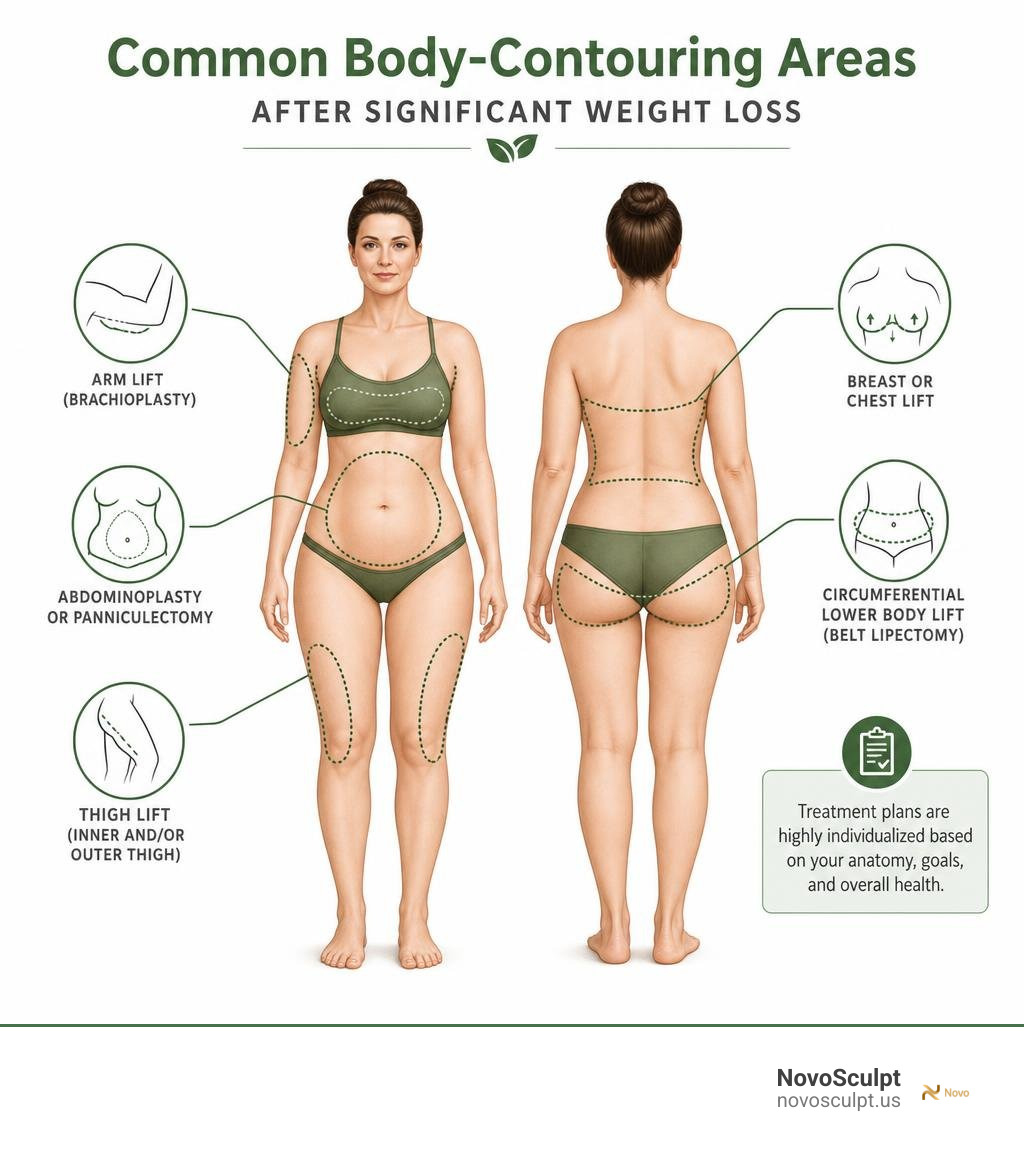
Post-weight-loss body contouring often involves more than one body area, but each procedure addresses a different anatomical problem. A thoughtful plan may stage procedures over time rather than attempting to treat every concern at once. The goal of consultation is treatment selection: matching the patient’s loose skin, residual fat, muscle laxity, recovery tolerance, and goals to the appropriate body-contouring or plastic surgery option after weight loss.
What Is a Panniculectomy?
A panniculectomy removes the hanging lower abdominal apron of skin and fat called the pannus. It is often considered when the pannus contributes to hygiene problems, irritation, mobility limitations, or recurrent skin-fold symptoms. It generally does not tighten the abdominal muscles or reshape the entire waist in the same way as a cosmetic abdominoplasty (Panniculectomy, StatPearls).
What Is an Abdominoplasty or Tummy Tuck After Weight Loss?
An abdominoplasty removes excess abdominal skin and can tighten the abdominal wall when diastasis recti or muscle laxity is present. It is often the better-known option for patients searching for a tummy tuck after weight loss, but it requires individualized assessment because the incision pattern, anesthesia plan, recovery, and risks vary (Abdominoplasty, StatPearls; MedlinePlus).
What Is a Circumferential Lower Body Lift?
A lower body lift, sometimes called a belt lipectomy, treats laxity around the abdomen, hips, outer thighs, and buttocks. It is usually reserved for patients with more extensive circumferential redundancy and involves a larger operation than limited awake contouring. Reviews of massive-weight-loss body contouring describe lower body lift procedures as addressing the circumferential nature of lower-trunk laxity in selected patients (Boswell, 2010; Kitzinger et al., 2012).
What Is an Arm Lift or Brachioplasty?
Brachioplasty removes loose upper-arm skin that may hang from the underarm toward the elbow after major weight loss. It can improve friction and clothing fit, but it also creates a visible scar that must be discussed before surgery. StatPearls describes brachioplasty as an upper-arm lift procedure used to address excess upper-arm skin and soft tissue, including after massive weight loss (Brachioplasty, StatPearls).
What Is a Thigh Lift?
A thigh lift removes redundant inner-thigh and/or outer-thigh skin when friction, rubbing, or laxity is significant. The procedure is different from liposuction alone because it is designed to excise skin rather than simply reduce fat volume. Thigh lift procedures are commonly discussed within post-massive-weight-loss body-contouring plans, often alongside lower body lift, abdominoplasty, and brachioplasty (ASPS; Kitzinger et al., 2012).
What About Breast or Chest Lift Procedures?
Weight loss can reduce breast or chest volume and leave stretched skin. A breast lift, chest lift, fat transfer, implant-based augmentation, or other reconstructive plan may be considered depending on anatomy, sex, goals, and medical history. These procedures should be discussed with a qualified clinician who can evaluate the patient’s anatomy and risk profile.
Where May NovoSculpt Fit?
NovoSculpt may be appropriate when the dominant concern is localized residual fat, contour irregularity, or limited skin laxity rather than major circumferential excess skin. A physician-led evaluation can help determine whether awake/minimally invasive body contouring, liposuction after weight loss, NovoTight, NovoTuck, or a combined local/tumescent-anesthesia approach is reasonable—or whether the patient’s anatomy and goals are better addressed with conventional excisional plastic surgery.
Patients should not assume that one approach is automatically “better.” A plastic surgeon for loose skin after weight loss or a qualified body-contouring physician evaluates the type of tissue excess, the body areas involved, the patient’s health status, and the amount of correction required.
Recovery After Body Contouring: Conventional Surgery vs Awake Treatment
Recovery after body contouring after weight loss varies widely. A lower body lift, abdominoplasty, panniculectomy, brachioplasty, or thigh lift has a different recovery profile from targeted awake liposuction, limited skin excision, or skin-tightening after weight loss. Patients should follow the specific instructions of the physician who performed their procedure.

How Is Recovery Different After Major Excisional Surgery?
Conventional post-massive-weight-loss plastic surgery can involve larger incisions, drains, activity restrictions, scar care, and several weeks of modified activity. Recovery is influenced by the number of areas treated, whether muscle repair is performed, the patient’s nutritional status, medical conditions, nicotine exposure, and the surgeon’s protocol. Reviews of post-bariatric abdominoplasty and body contouring identify factors such as BMI, smoking, nutritional status, and procedure extent as relevant to complication risk and recovery planning (Sisti et al., 2022; Panniculectomy, StatPearls).
Common themes may include early gentle walking, incision care, temporary swelling, compression when prescribed, drain care when drains are used, and a gradual return to exercise after medical clearance. Exact timelines—such as when drains are removed, when compression stops, or when heavy lifting resumes—should not be generalized because they vary by operation and surgeon.
How Is Recovery Different After Awake NovoSculpt Procedures?
Selected NovoSculpt procedures can be performed awake with local/tumescent anesthesia. For appropriately selected patients and treatment areas, this may allow a different and often less extensive recovery plan than major excisional plastic surgery, but it is still a medical procedure with swelling, bruising, soreness, incision care, and activity guidance.
Patients considering NovoSculpt should receive procedure-specific instructions directly from the practice. A limited fat-removal or skin-tightening procedure is not the same recovery experience as an abdominoplasty, panniculectomy, or lower body lift, and it should not be marketed as if it replaces those operations.
What Questions Should You Ask Before Choosing a Procedure?
- Is my main issue loose skin, residual fat, muscle separation, or a combination?
- Would skin removal after weight loss require a large excision, or is a limited approach realistic?
- Am I a better candidate for an awake/minimally invasive body-contouring approach or a more extensive conventional excisional plastic surgery procedure?
- Will my procedure be done awake with local/tumescent anesthesia, under sedation, or under general anesthesia?
- What scars should I expect, and where will they be placed?
- What recovery restrictions apply to my exact procedure?
- What type of plastic surgeon for loose skin after weight loss or body-contouring specialist should evaluate my goals?
- What medical issues, nutrition concerns, or nicotine-related risks should be addressed before treatment?
Costs, Insurance, Local Care, and Long-Term Maintenance
Costs for body contouring after weight loss depend on the procedure type, number of areas treated, anesthesia plan, facility setting, surgeon expertise, geographic market, and whether the goal is functional reconstruction or cosmetic contour refinement. Patients should ask for a written estimate that separates surgeon fees, facility fees, anesthesia fees when applicable, garments, follow-up visits, and possible staged procedures.
Does Insurance Cover Skin Removal After Weight Loss?
Insurance coverage should never be assumed. Some health plans may cover procedures such as panniculectomy when plan-specific medical-necessity requirements are satisfied, especially when documentation shows functional problems such as chronic irritation, hygiene difficulty, infection, or mobility impairment. Cosmetic contouring, liposuction, skin tightening, and aesthetic refinements are generally not covered. Requirements vary substantially by insurer and plan, so patients should confirm benefits, documentation rules, preauthorization requirements, exclusions, and appeal options directly with their insurer.
Where Does NovoSculpt Fit for Local Patients?
NovoSculpt has one physical location in Cos Cob/Greenwich, Connecticut. The practice serves patients from Greenwich, Fairfield County, Connecticut, and nearby Westchester County, New York without implying separate offices in surrounding towns.
For selected candidates, NovoSculpt offers awake minimally invasive surgical body contouring, fat removal, skin tightening, and limited skin-excision options using local/tumescent anesthesia when appropriate. For patients whose anatomy or goals require more extensive skin removal surgery, a conventional excisional plastic surgery plan may be more appropriate.
Patients who want to explore whether their concern fits a NovoSculpt approach can learn more about NovoSculpt services or schedule a personalized NovoSculpt consultation.
How Long Do Results Last?
Body-contouring results can be long-lasting, especially when weight remains stable, but they are not immune to aging, pregnancy, gravity, or future weight change. Removed skin does not return in the same way, but remaining skin and fat distribution can change over time.
To support the result:
- Maintain a stable weight: Large weight fluctuations can stretch remaining skin or change fat distribution.
- Prioritize nutrition: Protein, hydration, and appropriate micronutrients support healing and tissue maintenance.
- Follow scar-care guidance: Once cleared by the surgeon, silicone-based scar care, sun protection, and time may help scars mature as favorably as possible, but scar appearance varies by genetics, skin tone, incision tension, healing, and procedure type.
- Keep follow-up appointments: Postoperative visits help identify healing issues early and keep recovery on track.
Frequently Asked Questions About Body Contouring After Weight Loss
What Type of Body Contouring or Plastic Surgery Is Appropriate After Weight Loss?
The appropriate option depends on the patient’s anatomy and goals. A physician evaluates whether the main concern is major loose skin, localized residual fat, muscle separation, limited laxity, or a combination. Some patients are better candidates for conventional excisional plastic surgery, such as panniculectomy, abdominoplasty/tummy tuck, brachioplasty/arm lift, thigh lift, or lower body lift. Others may be candidates for liposuction after weight loss, limited skin excision, awake/minimally invasive body contouring, or selected skin-tightening approaches.
What Is the Best Body Contouring After Weight Loss?
The best body contouring after weight loss is the procedure that matches the anatomical problem. Major loose skin may require plastic surgery after weight loss, such as panniculectomy, abdominoplasty, brachioplasty, thigh lift, or lower body lift. Localized residual fat may be treated with liposuction or awake body contouring in selected patients. Mild laxity may improve modestly with skin-tightening approaches, but non-invasive devices cannot remove large folds of excess skin.
How Much Weight Do You Lose From Body Contouring Surgery?
Body contouring is not a weight-loss operation. Some tissue weight is removed during skin removal or fat removal, but the goal is contour, comfort, hygiene, mobility, clothing fit, and quality of life rather than scale-weight reduction.
Is NovoSculpt the Same as Non-Surgical Body Contouring?
No. NovoSculpt procedures are surgical or minimally invasive medical procedures performed by a physician-led practice. They are not the same as cryolipolysis, spa-based treatments, or non-invasive body-contouring devices. Selected procedures may be performed awake using local/tumescent anesthesia when clinically appropriate.
Can NovoSculpt Replace a Tummy Tuck, Panniculectomy, or Lower Body Lift?
Not for patients who truly need extensive excisional surgery. NovoSculpt may fit selected patients with localized residual fat and/or more limited laxity, but a major pannus, circumferential loose skin, significant diastasis recti, or extensive post-bariatric redundancy may be better treated by a conventional plastic surgery procedure.
Does Liposuction Tighten Loose Skin After Weight Loss?
Liposuction removes localized subcutaneous fat; it does not remove a large skin apron, repair diastasis recti, or replace a lower body lift or abdominoplasty when significant skin redundancy is present. Skin response after liposuction depends on skin elasticity, age, tissue quality, the area treated, and the amount of laxity.
How Visible Are Body-Contouring Scars Over Time?
Scars are permanent, and their final appearance varies by genetics, skin tone, incision tension, procedure type, scar care, and sun exposure. Many scars gradually flatten and fade over time, but no surgeon can guarantee an invisible or specific scar result.
Can Loose Skin Return After Body Contouring Surgery?
Removed skin does not grow back in the same way, but the remaining skin can stretch or loosen with aging, pregnancy, gravity, or future weight change. Maintaining a stable weight helps preserve the improvement.
When Should Someone See a Plastic Surgeon or Body-Contouring Physician?
A consultation is appropriate when loose skin, residual fat, chafing, hygiene issues, clothing-fit problems, or contour concerns remain after weight loss and weight has stabilized enough for meaningful evaluation. The consultation should clarify whether the concern is best addressed by conventional plastic surgery, an awake/minimally invasive approach, non-invasive treatment, or no procedure at that time.
Final Thoughts
Body contouring after weight loss works best when the procedure matches the anatomy. Some patients need conventional post-massive-weight-loss excisional plastic surgery; others may be candidates for liposuction, limited skin excision, awake/minimally invasive body contouring, or skin tightening after weight loss. The key is not choosing the trendiest procedure—it is choosing the medically appropriate one after individualized physician evaluation.
NovoSculpt offers physician-led awake minimally invasive surgical body-contouring options in Cos Cob/Greenwich for selected patients in Fairfield County and nearby Westchester County. A personalized NovoSculpt consultation can help determine whether your concern is primarily loose skin, residual fat, or both—and whether an awake body-contouring approach or a more extensive conventional procedure may be appropriate.
References
American Society of Plastic Surgeons. “Body Contouring.” ASPS.
Boswell CB. “Body contouring following massive weight loss.” Missouri Medicine. 2010. PMCID: PMC6188338.
Kitzinger HB, Abayev S, Pittermann A, Karle B, Kubiena H, Bohdjalian A, Langer FB, Frey M. “After massive weight loss: patients’ expectations of body contouring surgery.” Obesity Surgery. 2012. PMC.
Sisti A, Cuomo R, Zerini I, et al. “Post-Bariatric Plastic Surgery: Abdominoplasty, the State of the Art in Body Contouring.” Journal of Clinical Medicine. 2022. PMC.
StatPearls. “Panniculectomy.” National Library of Medicine. NCBI Bookshelf.
StatPearls. “Abdominoplasty.” National Library of Medicine. NCBI Bookshelf.
StatPearls. “Brachioplasty.” National Library of Medicine. NCBI Bookshelf.
MedlinePlus. “Considering plastic surgery after a large weight loss.” U.S. National Library of Medicine. MedlinePlus.
MedlinePlus. “Tummy tuck.” U.S. National Library of Medicine. MedlinePlus.
